
Good homework help tips aren’t really about the homework itself — they’re about the habits a child builds while doing it, and that’s a distinction most well-meaning parents miss. In my years of teaching, I’ve noticed the students who struggled most weren’t the ones whose parents helped too little, but the ones whose parents had quietly started doing the thinking for them. This guide walks through sixteen practical strategies for staying genuinely involved without taking over, so homework time builds real independence instead of dependence on someone else finishing the thought. Each idea here comes straight from what actually works in a real classroom and a real home.
Start Here: Set a Consistent Routine
Every other strategy on this list works better once homework happens at a predictable time and place — it’s the foundation everything else builds on, and it costs nothing to start tonight.
Set a Consistent Routine
- The same time and place each day removes the daily negotiation over when homework actually starts.
- A predictable routine reduces the anxiety some kids feel about an open-ended, unscheduled task.
- Involve your child in choosing the specific time, which builds genuine buy-in rather than resistance.
- Consistency matters more than the exact time chosen — right after school or right after dinner both work.
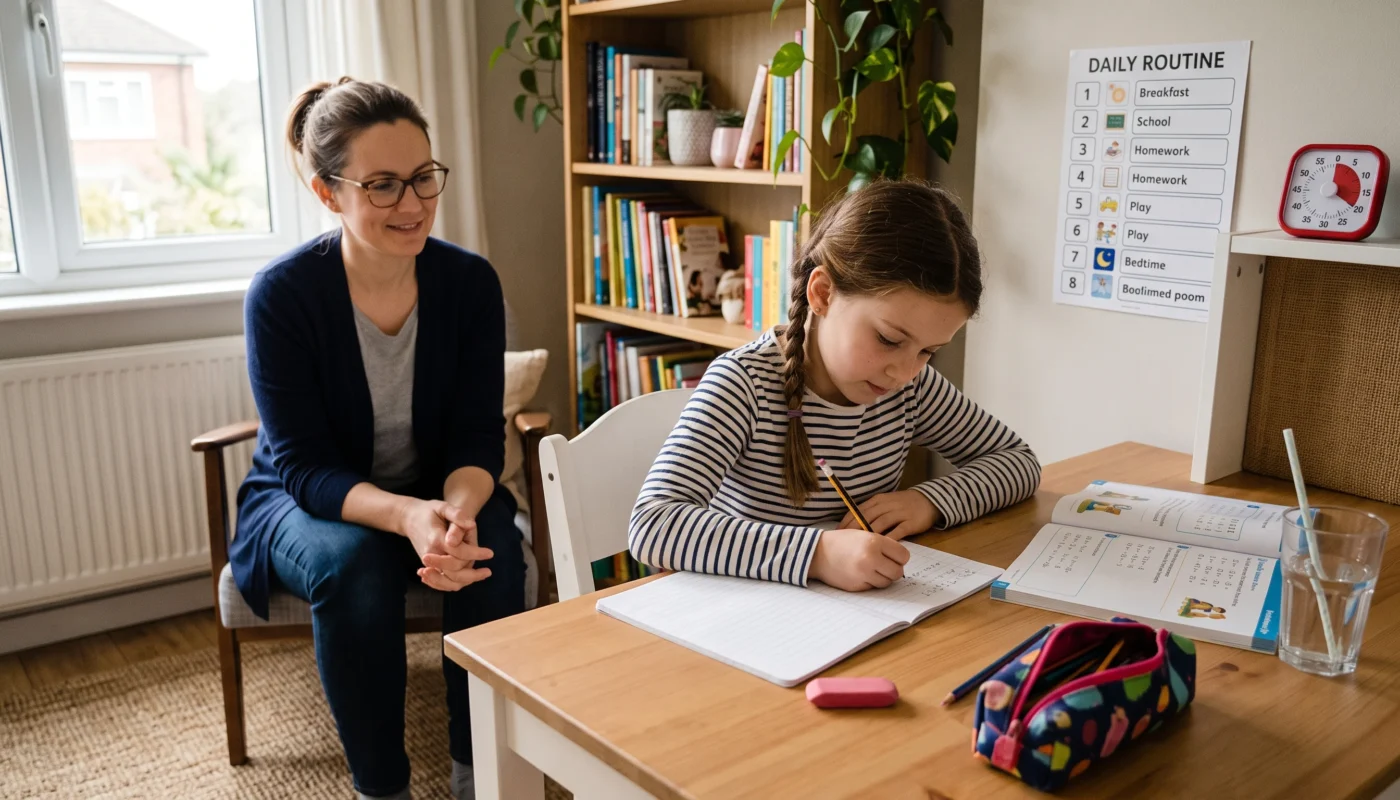
A consistent homework routine is the foundation every other strategy on this list depends on, since a predictable time and place removes the daily negotiation that otherwise eats up energy before any actual work begins. In my years of teaching, the students who struggled least with homework weren’t necessarily the strongest academically — they were the ones whose evenings followed a routine steady enough that homework simply happened, the same way brushing teeth happens, without needing a fresh conversation about it each night, since the decision had already quietly been made ahead of time.
A predictable structure also reduces the low-grade anxiety some kids feel about an open-ended task with no clear starting point, since knowing exactly when homework begins removes one layer of resistance before the work itself even starts. Letting your child have a genuine say in choosing the specific time, right after school or right after dinner, builds real buy-in rather than a rule handed down from above. The exact time matters far less than simply picking one and holding to it consistently, week after week, without much second-guessing.

Create a Distraction-Free Space
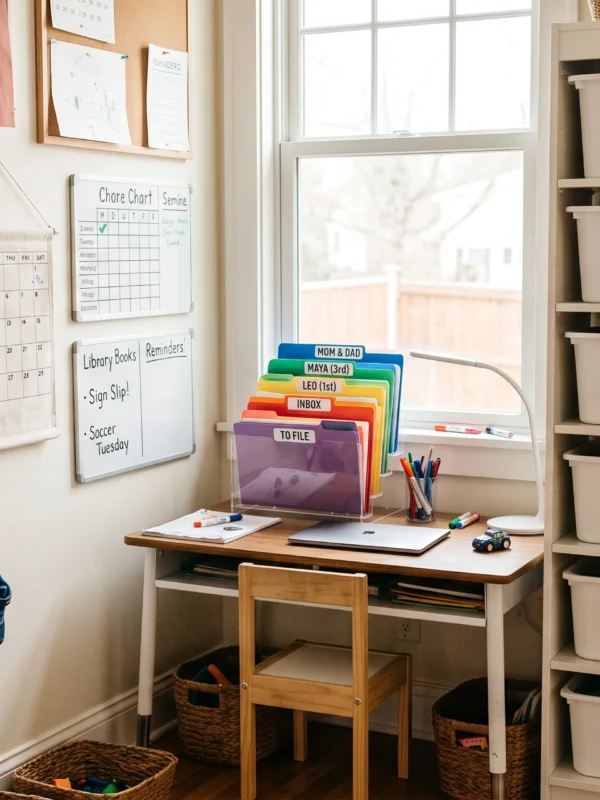
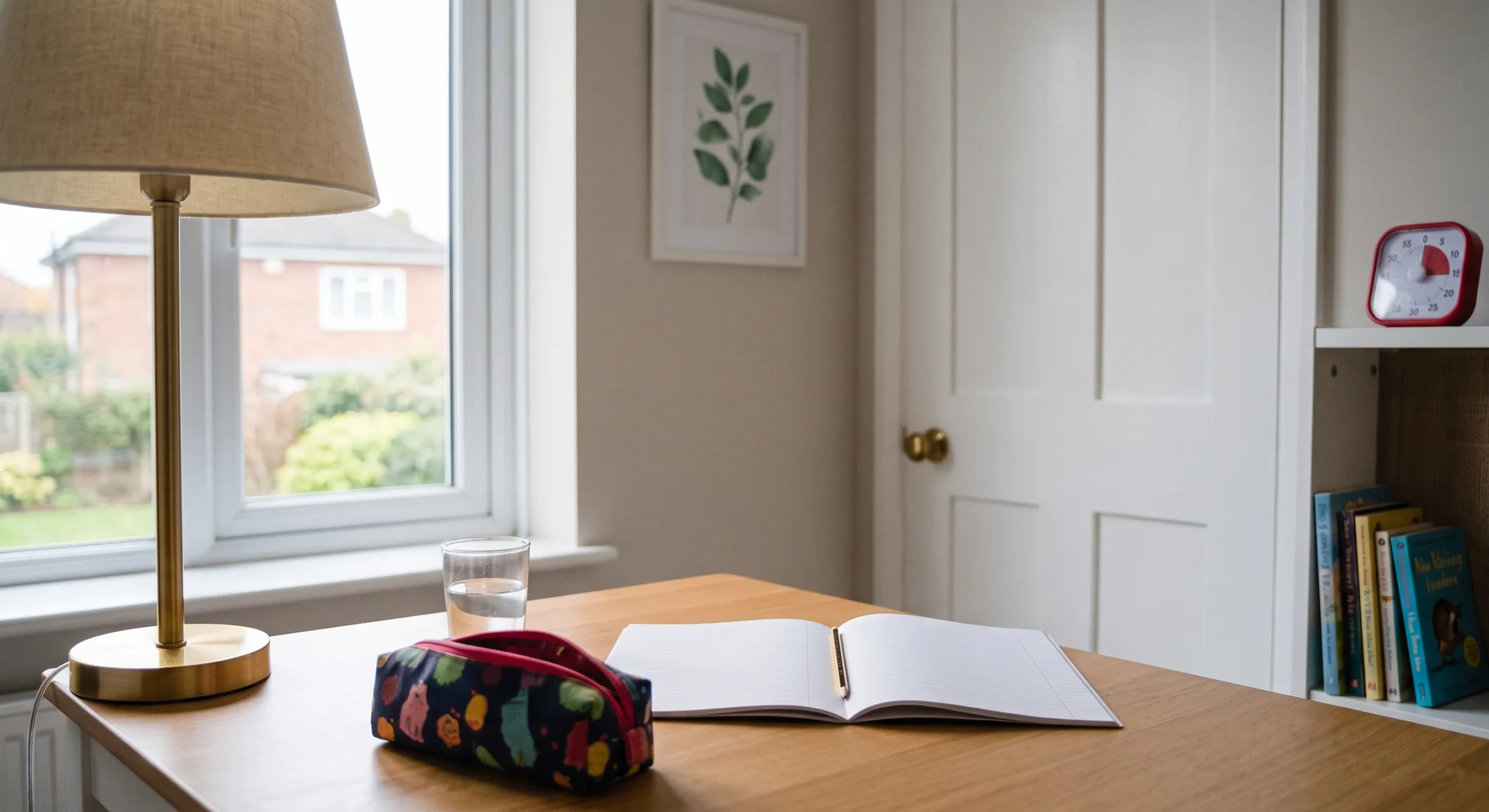
A distraction-free space doesn’t require an elaborate home office setup — it just needs to be consistent and reasonably clear of the things most likely to pull focus away. A dedicated spot, even a small cleared corner of a kitchen table, signals to a child’s brain that this particular location means it’s time to focus, the same way a classroom desk does during the school day. That environmental cue does real work on its own, before a single problem actually gets solved that evening, simply by shifting the mental gears into focus mode.
Removing phones and tablets from view matters more than most families initially expect, since research on attention consistently shows that a visible device pulls at focus even when it stays silent and untouched the entire time. This doesn’t mean banishing every device permanently, just keeping the immediate homework area clear of anything that isn’t needed for the specific assignment at hand. A quiet, consistent spot genuinely makes independent focus easier to sustain for longer stretches of time, night after night, without a constant battle over attention.
- A dedicated homework spot, even a small one, signals to a child’s brain that it’s time to focus.
- Removing phones and tablets from view matters more than most families expect, even when they’re just nearby.
- This doesn’t require a full home office — a cleared corner of a kitchen table works fine.
Ask Guiding Questions
- Questions like ‘what does the problem actually ask?’ redirect a child back to their own thinking.
- Asking rather than telling keeps the ownership of the answer with the child, not the parent.
- This takes real practice for parents used to jumping straight to the correct answer.
- A simple ‘what have you tried so far?’ often reveals the child already knows more than expected.
Guiding questions are the single most useful tool on this entire list, and also the hardest habit to build, since the instinct to simply explain the answer runs deep for most parents. A question like “what does the problem actually ask you to find?” redirects a child back to their own thinking rather than handing them a shortcut, which is exactly the kind of scaffolding I relied on constantly in my own classroom when a student got stuck partway through a problem and needed a nudge, not an answer.
Asking instead of telling keeps genuine ownership of the answer with the child, which matters more for long-term learning than getting tonight’s specific worksheet finished correctly. A simple “what have you tried so far?” often reveals that a child already understands more than either of you initially assumed, and simply needed a moment to organize that understanding out loud. This takes real, deliberate practice for a parent used to jumping straight to the correct answer out of habit, night after night, without even noticing it.
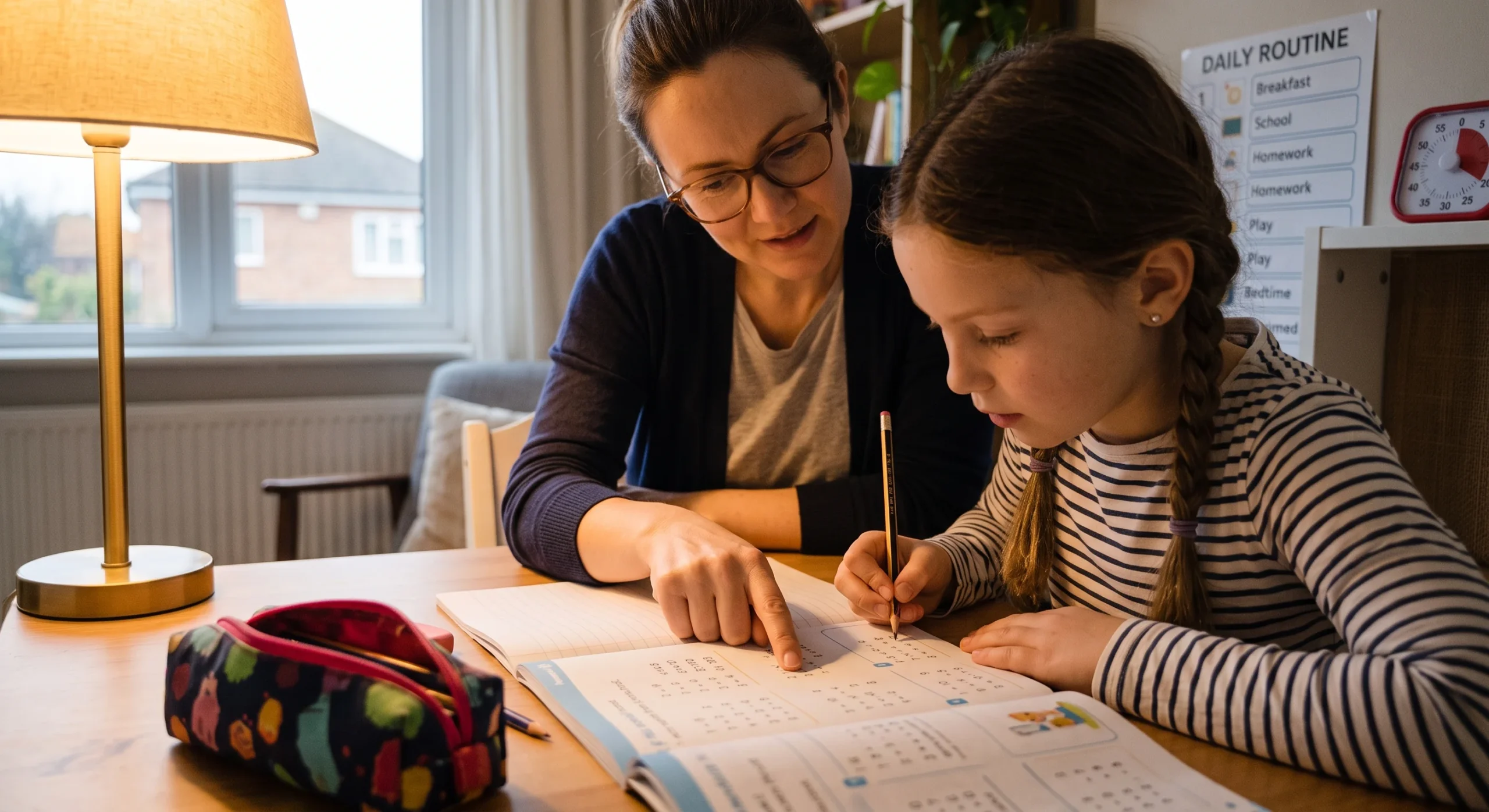
Try the Five-Minute Rule
The five-minute rule asks a reluctant child to commit to just five minutes of honest effort, with permission to stop after that if they genuinely want to. This small, low-pressure commitment lowers the barrier to starting, which is often the hardest part of any homework session, especially for a child who’s already decided in advance that a particular assignment is going to be difficult or boring before they’ve even looked closely at what it actually involves. Naming the limit out loud, just five minutes, makes the whole task feel considerably less permanent and far easier to actually approach.
What tends to happen in practice is that most kids, once they’ve actually started and found their footing, keep going well past the original five minutes without needing any further prompting from a parent. This works especially well for a child who avoids homework specifically because starting feels overwhelming, since the rule reframes the task as something temporary and manageable rather than an open-ended commitment. It’s a small psychological trick, but it genuinely works more often than not, especially once a child has seen it succeed a few times.
- Committing to just five minutes before quitting lowers the barrier to actually starting a hard task.
- Most kids, once started, keep going well past the original five minutes without prompting.
- This works especially well for a child who avoids homework because starting feels overwhelming.

Break Tasks Into Chunks
- Dividing a large assignment into smaller, numbered parts makes an overwhelming task feel genuinely manageable.
- Checking off each completed chunk gives a child a real sense of visible progress along the way.
- This works especially well for long-term projects or reading assignments with no natural stopping point.
- A simple sticky note or checklist is all that’s needed to break a task down this way.
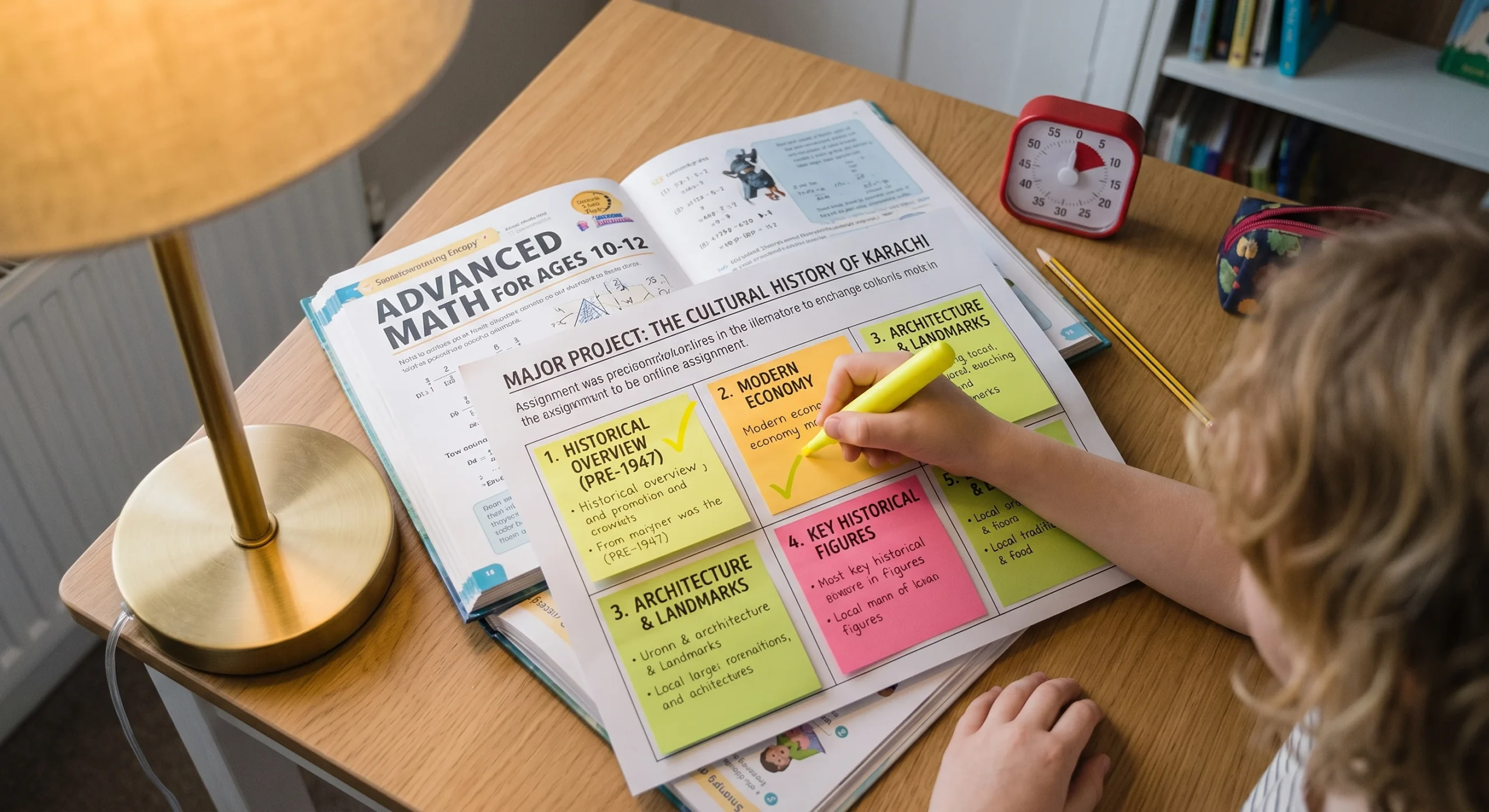
Breaking a large assignment into smaller, clearly numbered parts turns something that feels genuinely overwhelming into a series of manageable steps, each one small enough to actually start without much resistance. This matters most for longer assignments — a big reading log, a multi-page worksheet, a project with several components — where the sheer size of the task itself is often what causes the avoidance, more than any individual part being genuinely difficult on its own, once it’s actually broken down and looked at piece by piece.
Checking off each completed chunk along the way gives a child real, visible evidence of progress, which matters considerably for motivation during a task that might otherwise feel like it’s going nowhere. A simple sticky note listing three or four steps, or even just numbering sections directly on the worksheet itself, is genuinely all the structure this requires. This is a good strategy specifically for a child who tends to shut down when facing a large, undivided task with no clear place to begin at all, before it’s actually been broken apart.
Let Mistakes Happen
Letting mistakes happen is genuinely one of the hardest strategies on this list for a caring parent to follow, since watching a child write down a wrong answer while knowing the correct one feels almost impossible to sit through quietly. But a homework assignment with a few genuine errors on it gives a teacher real, honest information about what a child actually understands, which a perfect worksheet secretly corrected by a parent simply doesn’t provide, no matter how good the intentions behind fixing it quietly actually were in the moment.
In my years of teaching, the assignments that helped me most as a teacher were the ones with real mistakes still visible on them, since they showed me exactly where to focus the next day’s lesson. A child who’s allowed to be wrong sometimes also builds genuine resilience around making mistakes in general, learning that an error is information rather than a failure to be hidden. This is uncomfortable in the moment, but it genuinely serves a child far better over the long run than a spotless worksheet ever would.

Model Problem-Solving Aloud
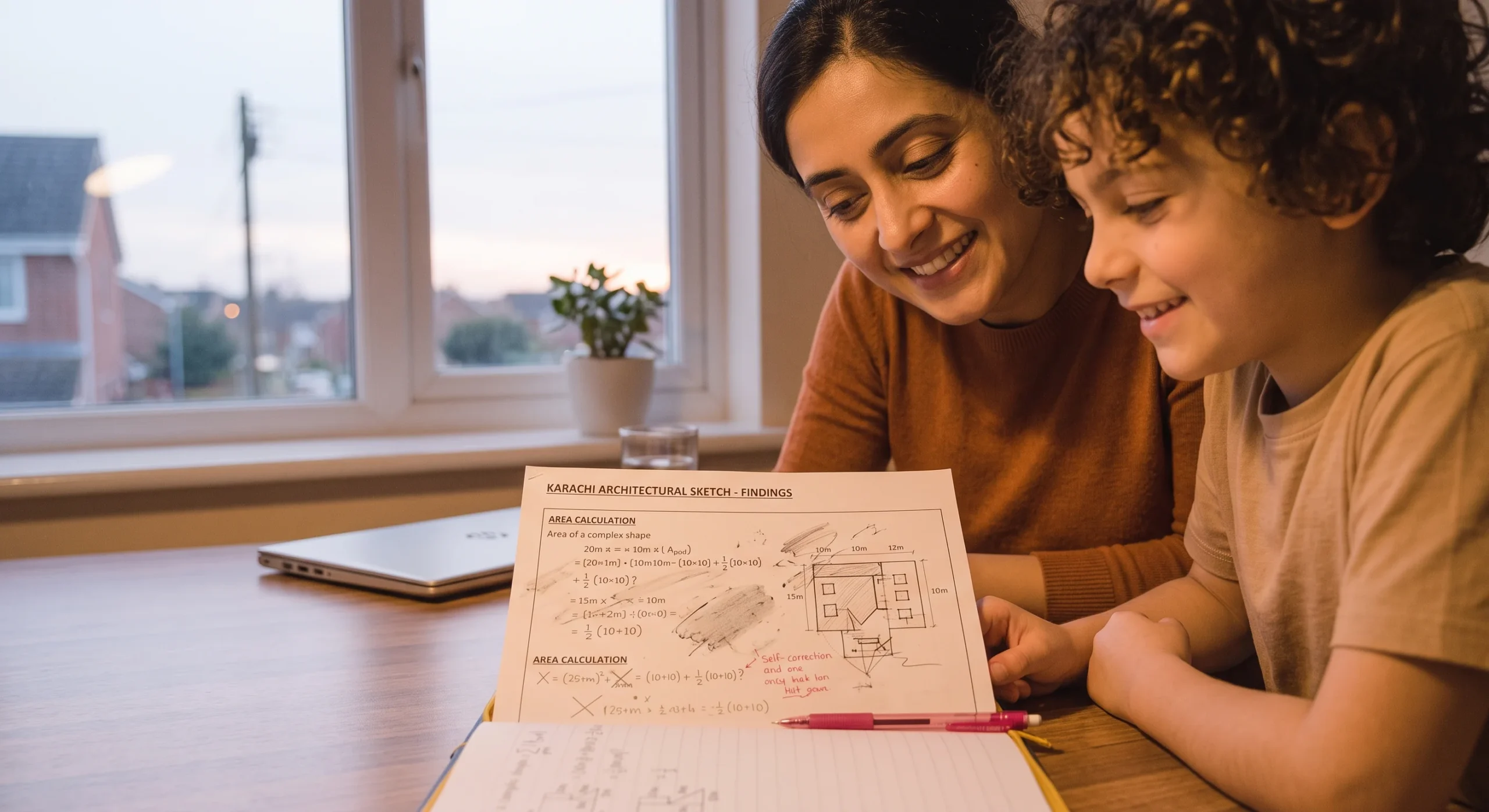
Modeling problem-solving aloud means narrating your own thinking process on a similar problem, out loud, so a child can hear what working through confusion actually sounds like rather than just seeing a finished, correct answer appear. This is a technique borrowed directly from classroom instruction, where a teacher regularly thinks aloud in front of students specifically to make an invisible mental process visible and, importantly, imitable for a child watching and listening closely from the sidelines. Kids genuinely learn a great deal simply from hearing an adult think through confusion without immediately arriving at the right answer.
This works best when applied to a similar but different problem, rather than the exact one a child is currently stuck on, since the goal is demonstrating a transferable approach rather than simply handing over that night’s specific answer. Deliberately making a small mistake and then correcting it out loud teaches something equally valuable: that self-correction is a completely normal part of working through a problem, not a sign that something has gone genuinely wrong along the way, but simply part of how real thinking actually happens.
- Talking through your own thinking out loud shows a child what problem-solving actually looks like in practice.
- This works best on a similar but different problem, not the exact one they’re stuck on.
- Making a deliberate small mistake and correcting it aloud teaches that self-correction is a normal part of the process.
Keep Snacks and Water Handy
- A simple snack before starting prevents low blood sugar from masquerading as a focus or attitude problem.
- Water within reach removes one common, genuine excuse for getting up and losing momentum.
- This is a small, easy step that removes a real physical barrier before homework even begins.
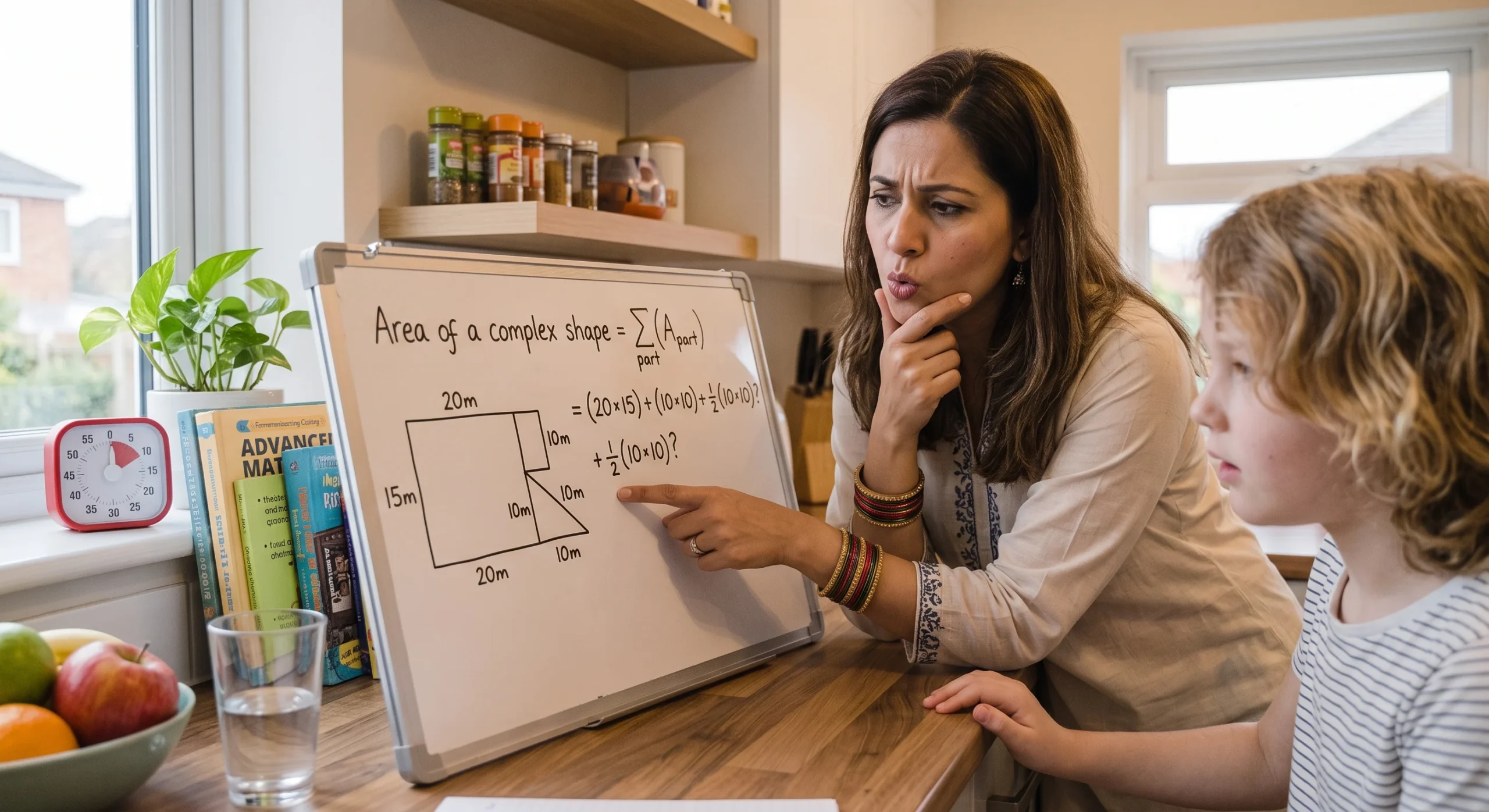
Keeping a simple snack and water within reach before homework starts addresses something genuinely physical rather than academic: a hungry or thirsty child struggles to focus for reasons that have nothing to do with the actual assignment in front of them. A quick snack — some fruit, crackers, a handful of nuts — prevents low blood sugar from showing up disguised as an attitude problem or a sudden inability to concentrate, which is easy to misread as defiance or laziness rather than a genuine, entirely fixable physical need.
Water within easy reach removes one of the most common, genuinely understandable excuses for getting up mid-task and losing whatever momentum had built up to that point. This is one of the smallest, easiest steps on this entire list, but it removes a real physical barrier before any actual homework strategy even gets a chance to work. A five-minute snack break beforehand is a small investment that often pays for itself many times over across a single evening alone, let alone a full week of homework sessions.
Watch for Frustration Signs
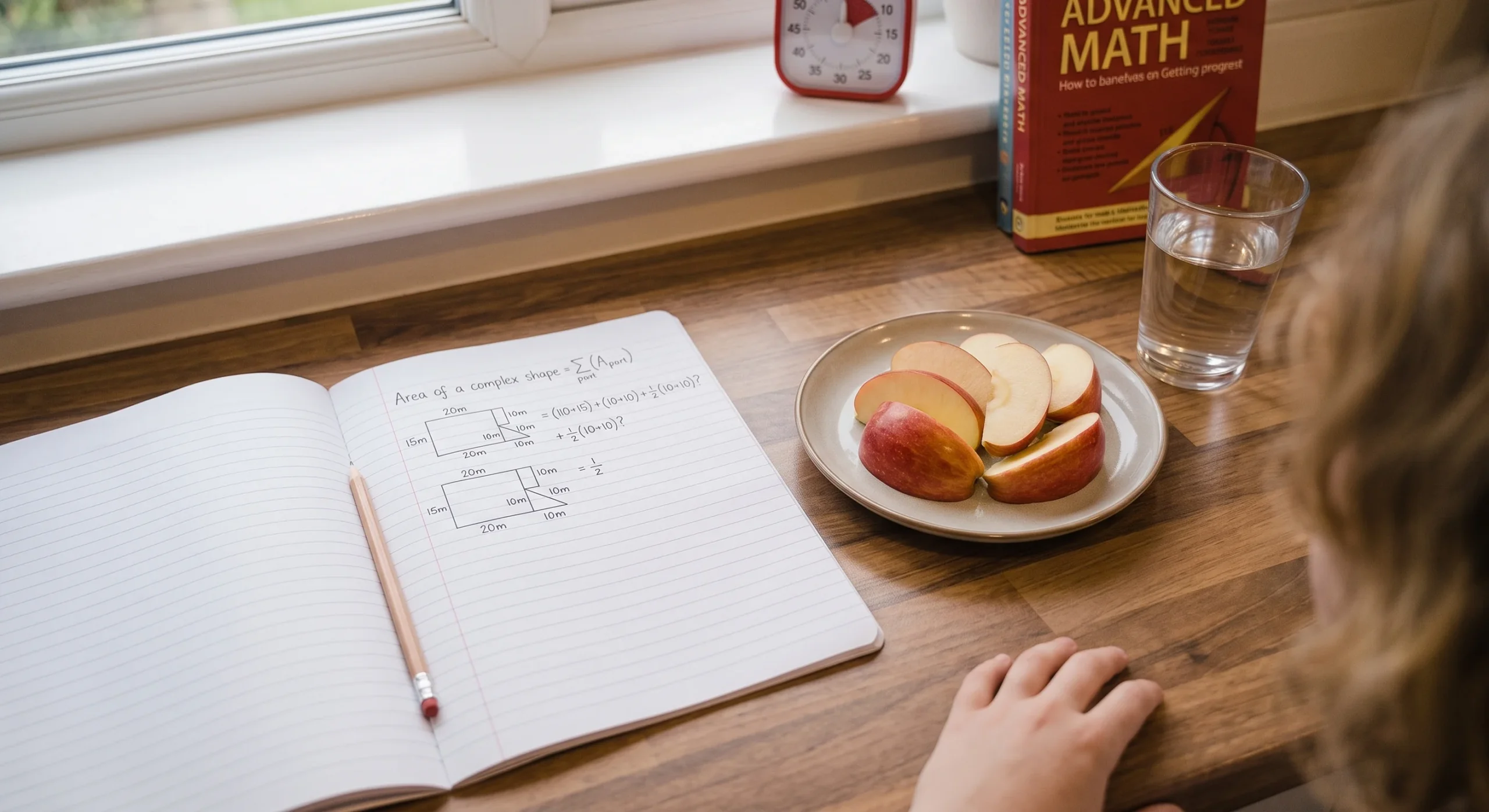
Watching for frustration signs means noticing the physical and behavioral cues that show up before a child actually says out loud that they’re stuck or overwhelmed — a tightening grip on the pencil, a sudden silence, crumpled paper, or a shift from focused effort to aimless doodling. Catching these signs early gives you a genuine window to step in with a guiding question or a short break before frustration hardens into a full shutdown or a tearful standoff over what started out as one single math problem.
In my years of teaching, the students who eventually disengaged from a subject entirely almost always showed these smaller warning signs for weeks before the bigger, more visible struggle appeared. A short break, a snack, or simply sitting quietly nearby for a minute is often enough to reset things at this early stage, well before frustration escalates into something that ends the whole homework session in tears. Learning to read your own child’s specific signs takes real time and attention, but it’s genuinely one of the most useful skills a parent can build.

Resist the Urge to Correct
- Pointing out every small error removes the child’s own chance to catch and fix mistakes independently.
- A simple ‘check that one again’ teaches self-review far better than circling the wrong answer directly.
- Save direct corrections for patterns of genuine misunderstanding, not single careless slips.
- This builds a habit of self-checking that serves a child well beyond any single assignment.
Resisting the urge to correct every small error is genuinely difficult, especially when the mistake is obvious and the fix would take five seconds to point out directly. But pointing out every error removes a child’s own chance to catch and correct mistakes independently, which is a skill that matters considerably more over time than any single night’s worksheet being entirely error-free from start to finish. Sitting with that discomfort, rather than reaching for the pencil yourself, is genuinely part of the work this whole approach asks of a parent.
A simple prompt like “check that one again” teaches genuine self-review far more effectively than circling the wrong answer and moving on, since it hands the actual correction work back to the child rather than doing it for them. Direct corrections are still worth saving for patterns of real misunderstanding, a concept genuinely not grasped, rather than single careless slips that a second look would catch on their own. This builds a self-checking habit that serves a child well beyond any one assignment or any single subject in school.

Use a Visible Timer
A visible timer gives a child a concrete, external sense of how much time remains, which helps with pacing in a way that a parent’s periodic verbal check-ins simply can’t replicate as consistently. Watching the countdown builds an internal sense of how long a task actually takes, a skill that most kids don’t develop naturally on their own and that becomes genuinely valuable well beyond homework, into test-taking, and eventually into adult work habits that quietly follow a person for the rest of their life.
This works especially well for tasks with a natural stopping point, like twenty minutes of reading or a set number of math problems, since the timer gives a clear, visible endpoint to work toward rather than an open-ended task with no defined finish line. Using a timer also shifts the responsibility for pacing onto the child rather than the parent, which is exactly the kind of independence this whole list is ultimately trying to build, one small habit at a time, long after the timer itself is put away.
- A visible countdown helps a child manage their own pacing without needing constant reminders from a parent.
- Timers work especially well for tasks with a natural stopping point, like a set number of problems.
- This shifts time management responsibility onto the child, building a skill that outlasts any single assignment.

Celebrate Effort Over Outcome
Celebrating effort over outcome means praising the sitting-down, the sticking-with-it, and the trying-again specifically, rather than reserving praise only for a correct final answer or a good grade. This distinction matters more than it might initially seem, since a child praised primarily for results tends to avoid genuinely challenging tasks where failure feels like a real risk, while a child praised for effort tends to take on harder problems more willingly over time, precisely because the effort itself, not just the final result, is what genuinely earns recognition in this house.
A simple “I noticed you kept trying even when that one was hard” does more for long-term motivation than “great job, you got it right,” even though the second one feels more natural to say in the moment. In my years of teaching, the students with the strongest long-term growth were consistently the ones who’d learned that effort itself was valued, not just correct answers on a page. This is a small shift in language, but it genuinely changes how a child approaches difficulty for years afterward.

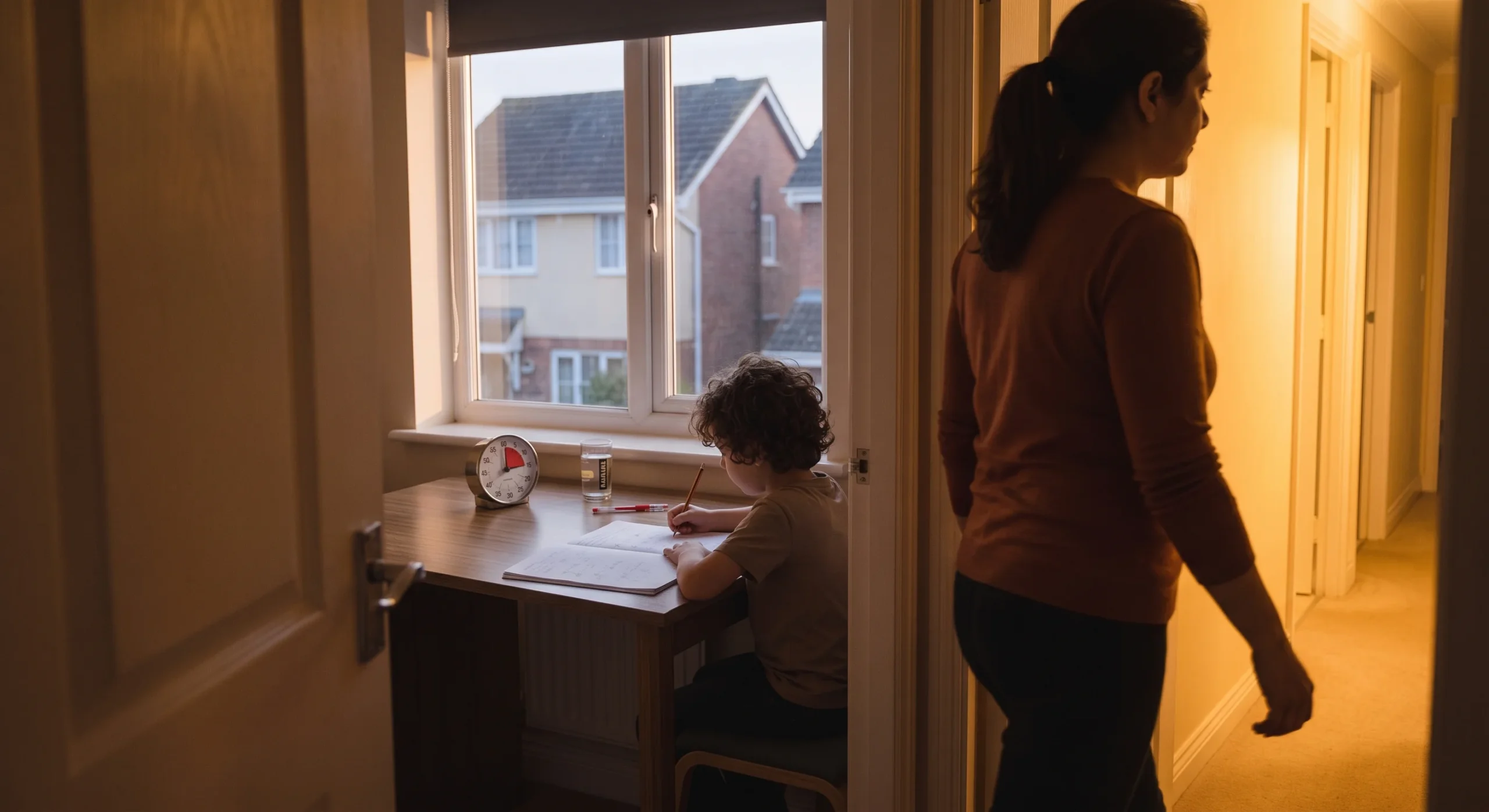
Know When to Step Back
Knowing when to step back entirely is the natural endpoint of everything else on this list, since the actual goal of homework help was never to be present for every single minute of it, but to build a child capable of working through things independently. Once a routine is established, a space is set up, and a child has practiced enough guided questions to internalize the approach, physically stepping out of the room for real stretches of time is a genuine sign of progress, not neglect.
This is often the hardest strategy to actually follow through on, since staying nearby can feel more like diligence than the withdrawal it might seem like on the surface. A good marker for readiness is whether a child can articulate their own confusion out loud without a parent prompting them to, since that’s a genuine sign the guiding-question habit has started to become internal rather than something that only happens when an adult is sitting right there. Trust that gradual withdrawal, done thoughtfully, is the actual goal.
Communicate With the Teacher
- A short email to the teacher about a recurring struggle often reveals context a parent wouldn’t otherwise have.
- Teachers generally welcome specific, brief updates far more than vague general concerns about performance.
- This helps a teacher adjust classroom support for a struggle that’s genuinely showing up consistently at home.
- Timing matters — reaching out early, before frustration builds up, tends to get a more useful response.
- This closes the loop between homework struggles at home and what’s actually happening during the school day.
Communicating with the teacher closes a loop that a lot of families never quite complete, treating homework struggles at home as separate from what’s actually happening during the school day, when the two are almost always connected. A short, specific email — “Ali is consistently struggling with the borrowing step in subtraction” — gives a teacher genuinely useful information they can act on, far more than a vague general note simply saying homework has been hard lately, without any real, actionable detail attached to it at all.
As a teacher, I always welcomed these specific updates far more than parents seemed to expect, since they let me adjust in-class support for exactly the struggle showing up consistently at home, rather than guessing at what a family might be dealing with each evening. Reaching out early, before frustration has had time to build into something bigger, tends to get a more useful, timely response than waiting until a struggle has become a genuinely entrenched pattern. This step alone often solves problems the other strategies can’t reach.

Build in Movement Breaks
Building in short movement breaks between tasks genuinely resets a child’s focus more effectively than pushing straight through mounting fatigue in the name of finishing faster. A few minutes of jumping jacks, a quick lap around the yard, or even simple stretching gets blood moving and attention refreshed in a way that sitting still through frustration never quite manages to achieve on its own, no matter how much sheer willpower a tired child tries to apply to the problem at hand that evening, long after real focus has already faded.
This especially benefits kids who have a genuinely hard time sitting still through a long, unbroken homework session, since a scheduled break gives restless energy somewhere legitimate to go rather than turning into fidgeting or an argument about focus. Scheduling the break in advance, rather than allowing it whenever asked, prevents it from becoming an open-ended escape from the actual work. A timer set for a five-minute break works well here too, keeping the break itself genuinely brief rather than stretching into the rest of the evening.
- A short movement break between tasks genuinely resets focus better than pushing through fatigue.
- Jumping jacks, a lap around the yard, or simple stretching all work equally well.
- This especially benefits kids who struggle to sit still through a long, unbroken homework session.
- Scheduling the break in advance prevents it from turning into an open-ended escape from the work.

Praise the Process Itself
- Naming the specific strategy a child used reinforces that strategy for the next time they get stuck.
- This closes out the list by reinforcing everything above it, turning strategy into lasting habit.
- A genuine, specific comment lands better than a generic ‘good job’ repeated every single night.
Praising the process itself closes out this list because it reinforces every other strategy covered above, turning a single night’s good habit into something a child starts reaching for on their own without needing to be reminded each time. Naming the specific strategy a child actually used — “I noticed you broke that big problem into smaller steps” — teaches them to recognize and deliberately repeat that same approach the next time they get stuck on something similarly difficult down the road, weeks or even months later.
A genuine, specific comment lands considerably better than a generic “good job” repeated every single night, since specificity signals that you were actually paying attention to how the work happened, not just whether it got finished. Over time, this kind of process-focused praise is what turns a list of parent strategies into a child’s own internal toolkit, which is really the entire point of everything covered in this guide, from the very first idea all the way through to this final one on the list.
FAQ
How much should I actually help with homework?
Enough to keep your child moving forward, not enough to finish their thinking for them. A good general rule is to step in only when they’re genuinely stuck after trying, not the moment a task looks hard.
What if my child gets frustrated and shuts down completely?
A short break is almost always more productive than pushing through in that moment — a few minutes away from the table, a snack, or some movement usually resets things enough to try again. If shutdowns happen regularly, it’s worth mentioning to the teacher, since it may point to something worth adjusting.
Should I check homework for mistakes before it’s turned in?
A quick look for completeness is fine, but resist correcting every wrong answer — a teacher genuinely benefits from seeing what a child doesn’t yet understand. If you notice a clear pattern of confusion, a note to the teacher is more useful than fixing it yourself.
At what age should kids start doing homework fully independently?
This varies by child, but by upper elementary, most kids can handle homework with just occasional check-ins rather than close supervision. The goal is a gradual handoff over several years, not an abrupt switch at one specific age.
Conclusion
The best homework help tips all point toward the same goal: a child who leaves the table not just with a finished worksheet, but with a little more confidence in their own ability to work through something hard. Every strategy here trades a small amount of short-term convenience for real long-term independence, and that trade is almost always worth making, even on the nights when it would genuinely be faster to just give the answer. Save this guide to Pinterest for the next tough homework night, try one strategy this week, and share it with another parent working through the same nightly struggle.