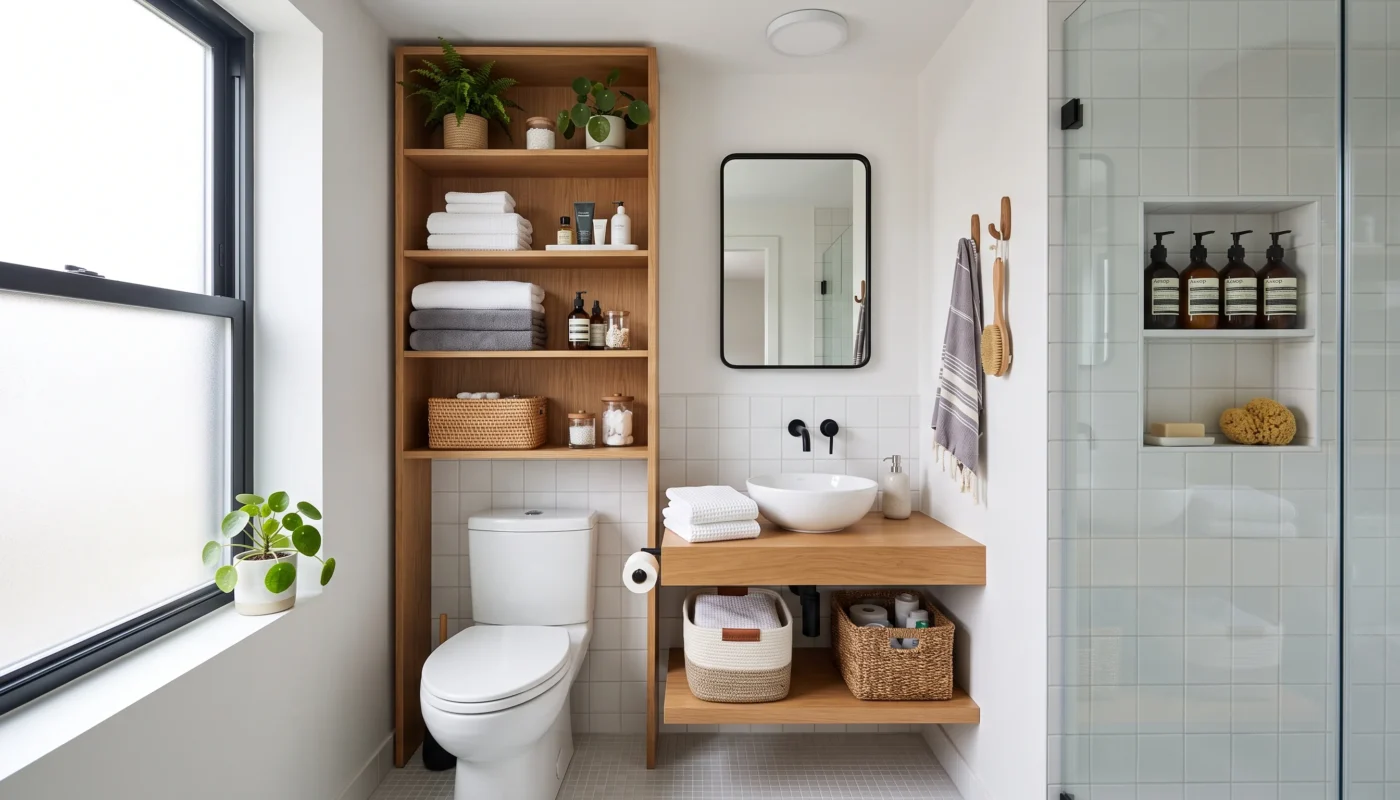

A small bathroom doesn’t have to mean a countertop buried under clutter. These small bathroom storage ideas are built around the same principle that guides any tight floor plan: use every surface, especially the vertical ones, before adding a single new piece of furniture. Rather than fighting the room’s actual dimensions, this list works with them — over the toilet, inside recessed niches, along the back of the door — so nothing goes to waste. Every idea here is chosen for genuine practicality in a real bathroom, not an idealized one. By the end, you’ll have a full toolkit for a room that finally feels calm instead of cramped.
Start Here: Over-Toilet Shelving
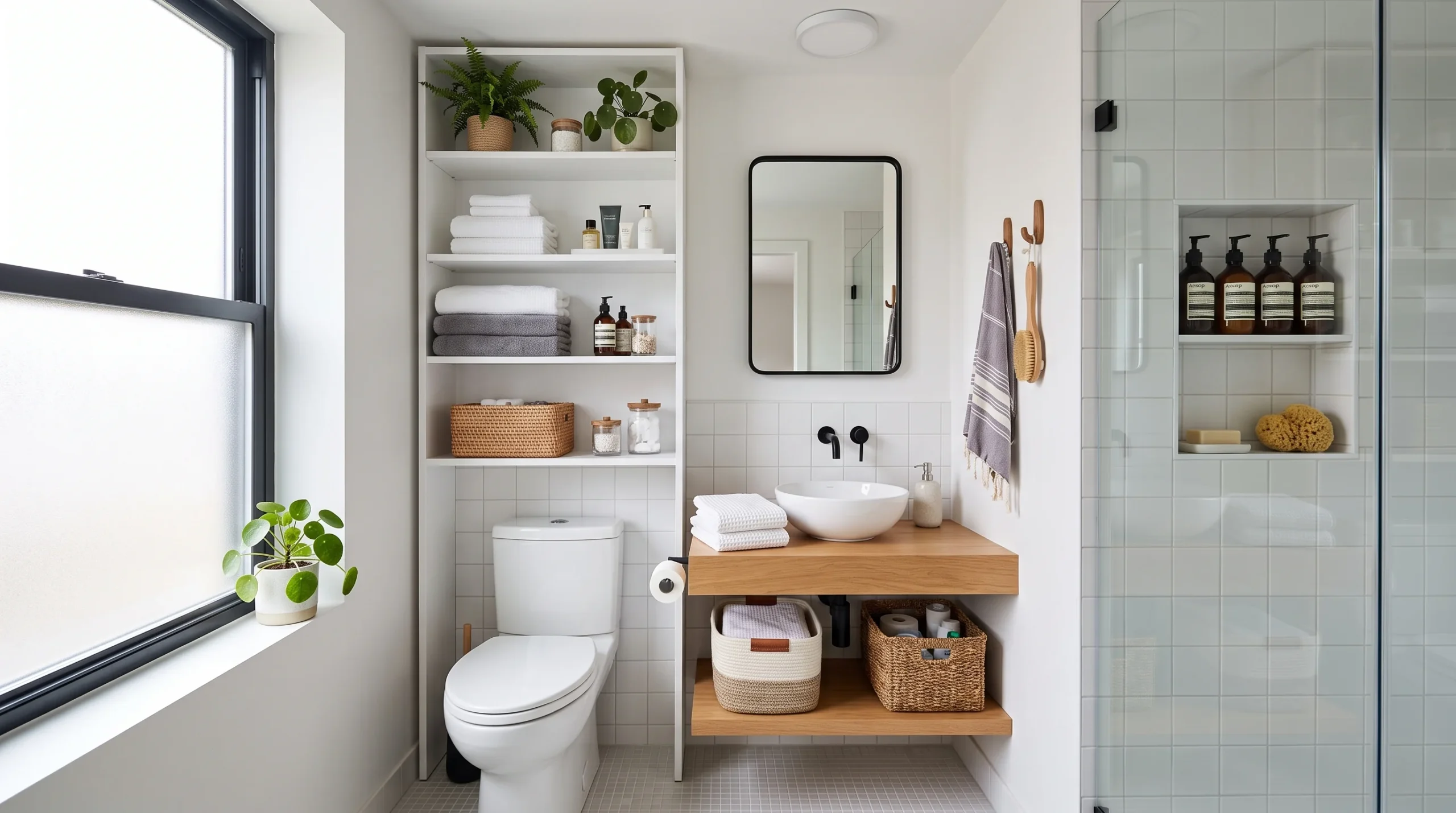
This is the single most overlooked storage zone in almost every small bathroom — it adds real shelving without touching the floor plan, and most units install in under an hour.
Over-Toilet Shelving
- An over-toilet unit uses the single most consistently wasted zone in almost any bathroom layout.
- Open shelving keeps items visible and accessible, unlike a closed cabinet that hides what’s stored inside.
- Most units are freestanding, requiring no drilling or wall anchors to install.
- Choose a unit sized to straddle your specific toilet tank width before buying.
The wall space directly above a toilet tank is, almost without exception, the single most wasted zone in a small bathroom’s entire footprint. An over-toilet storage unit captures that vertical volume, adding genuine shelf space in an area that would otherwise sit permanently empty. As an architect, I think of this as one of the lowest-cost, highest-return moves available in a small bathroom, since it requires no plumbing changes, no structural work, and often no installation beyond simply positioning the unit correctly around the tank.
Open shelving works better here than a closed cabinet in most cases, since visible storage keeps towels, extra toilet paper, and toiletries genuinely accessible rather than tucked behind a door that adds friction to daily use. Most freestanding units require zero drilling, which makes this one of the safest choices for renters who can’t modify walls. Measuring the tank’s width before buying matters, since a unit sized too narrow or too wide either wastes space or won’t straddle the toilet properly at all, leaving an awkward gap on either side.
Corner Shower Caddy
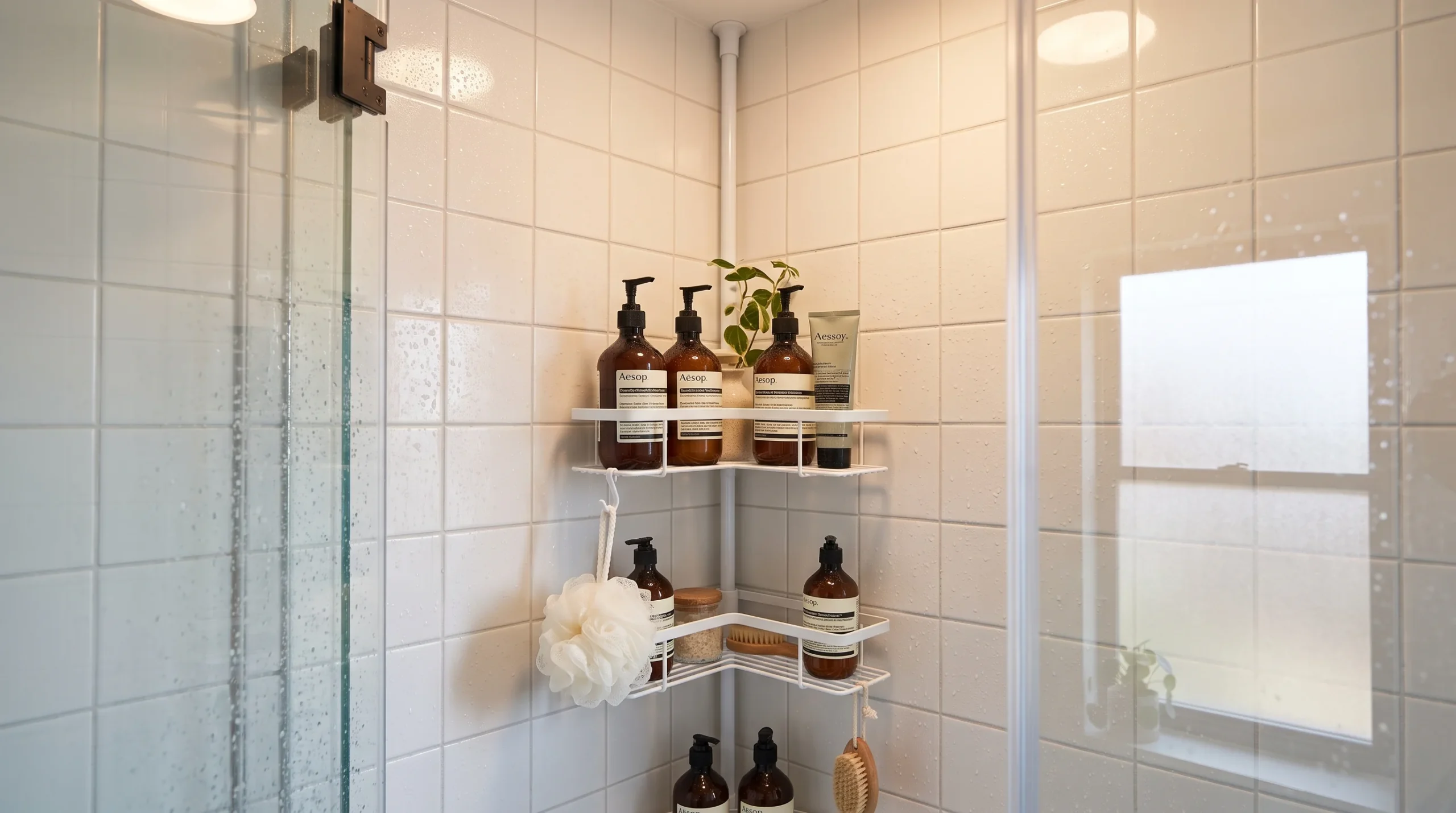
Corners are wasted space in almost every room, and a shower stall is no exception — the vertical corner above eye level typically holds nothing at all despite being fully within arm’s reach. A corner shower caddy claims that zone specifically, adding several tiers of genuine storage without touching the shower floor or reducing the actual standing area inside the stall. This is one of the highest-value small bathroom storage ideas relative to its cost, since a caddy this size typically runs under thirty dollars.
Tension-mounted versions, which wedge between floor and ceiling using spring pressure, need no drilling at all, making this one of the more reversible options on this list for anyone renting rather than owning. A slight downward tilt on each shelf, or small drainage holes built into the design, keeps water from pooling and encourages faster drying, which matters more in a humid shower environment than almost anywhere else in the bathroom. This small addition solves a storage problem most people don’t even realize they have.
- A corner caddy uses a shower’s most consistently wasted zone, the empty corner above eye level.
- Tension-mounted versions need no drilling, making this fully reversible for a rented bathroom.
- Choose shelves with a slight downward tilt or drainage holes so water doesn’t pool and mildew.
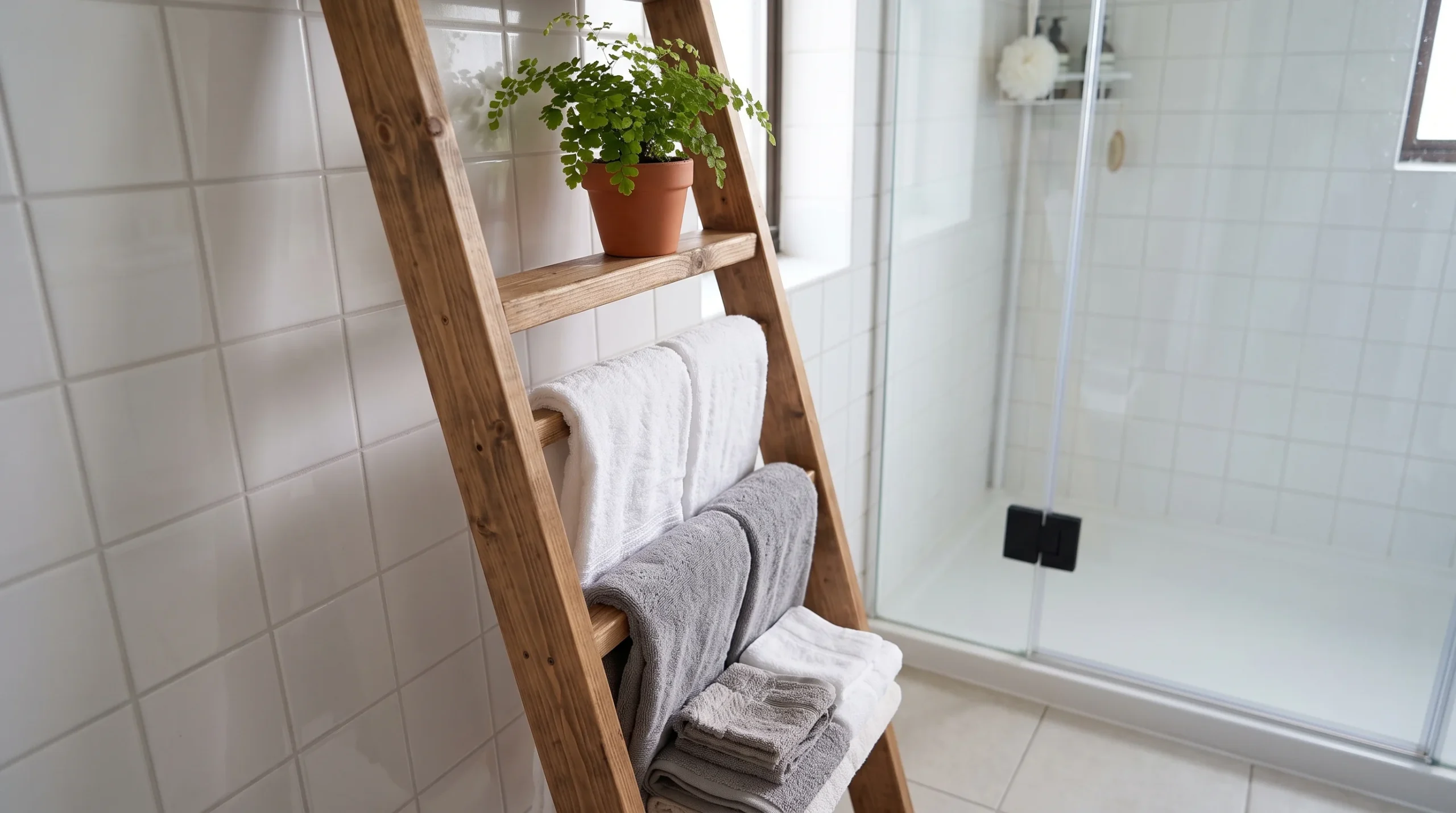
Vertical Towel Ladder
- A ladder shelf leans against the wall on its own footprint, needing no drilling or wall anchors.
- Each rung holds a rolled or folded towel, turning storage into a styled visual display.
- Works well in the narrow gap beside a vanity or tub where a flat shelf wouldn’t fit.
- Choose a ladder with a wide enough base to stay stable in a small, high-traffic room.
A vertical towel ladder solves the same structural problem as the leaning shelves used elsewhere in a small space: it distributes its entire load onto the floor rather than the wall, which means genuinely zero wall damage and zero drilling involved. In a bathroom specifically, this matters because tile walls are considerably harder to anchor into than drywall, making a leaning solution meaningfully easier to install than most wall-mounted alternatives. Each rung holds a rolled or folded towel, turning what would otherwise be a plain corner into a styled, functional display.
This works especially well in the narrow gap beside a vanity or tub, a space too slim for a standard shelf but perfectly suited to a ladder’s slim vertical profile. Choosing a ladder with a genuinely wide base matters in a small, high-traffic bathroom, where a narrow or unstable base risks tipping if bumped during a normal morning routine. This is a low-cost, fully reversible addition that adds real towel storage without asking anything structural of the room. Matching the ladder’s tone to existing fixtures helps it read as a deliberate choice rather than an afterthought.
Under-Sink Bins
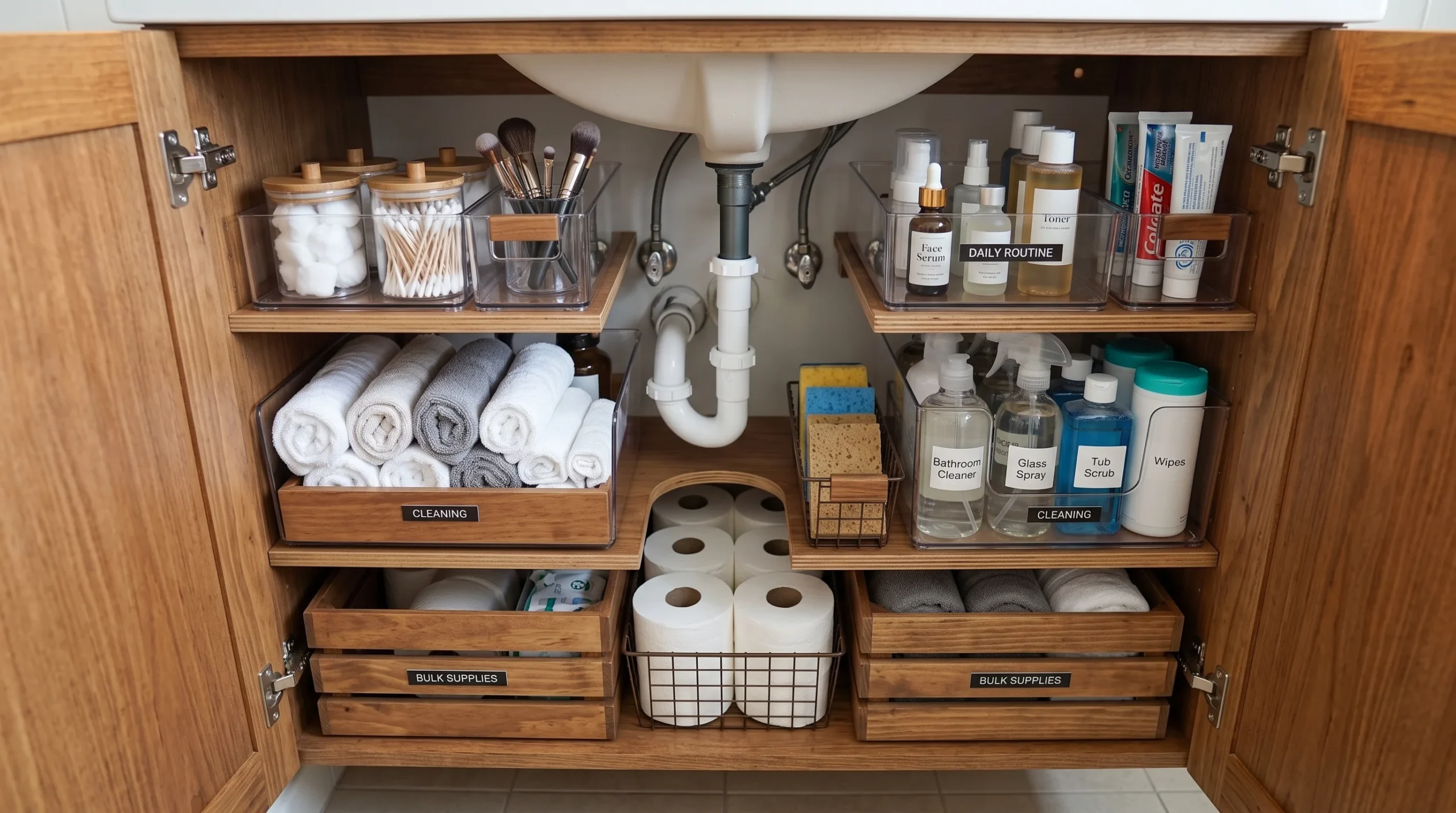
The cabinet beneath a bathroom sink is consistently one of the most poorly used storage zones in the entire room, largely because plumbing interrupts the space in a way that makes a single flat shelf genuinely impractical. Tiered bins are built specifically to work around that interruption, using the irregular space on either side of the pipes rather than leaving it empty by default. In a small bathroom, where every storage zone matters more than it would in a larger one, reclaiming this specific area adds up to real additional capacity.
Pull-out versions solve the access problem that makes under-sink storage frustrating in practice — reaching something at the back of a static shelf usually means removing everything in front of it first. This tends to work well as a dedicated zone for cleaning supplies, extra toiletries, and backup toilet paper, consolidating items that would otherwise compete for space on the counter or in a medicine cabinet. Measuring the specific pipe layout before buying matters, since under-sink shapes vary enough that a generic bin set won’t always fit.
- Tiered bins work around plumbing to use cabinet space that’s usually left mostly empty.
- Pull-out versions make items at the back genuinely accessible, unlike a static single shelf.
- This tends to work well for cleaning supplies, extra toiletries, and backup toilet paper in one zone.
Mirror Cabinet Storage
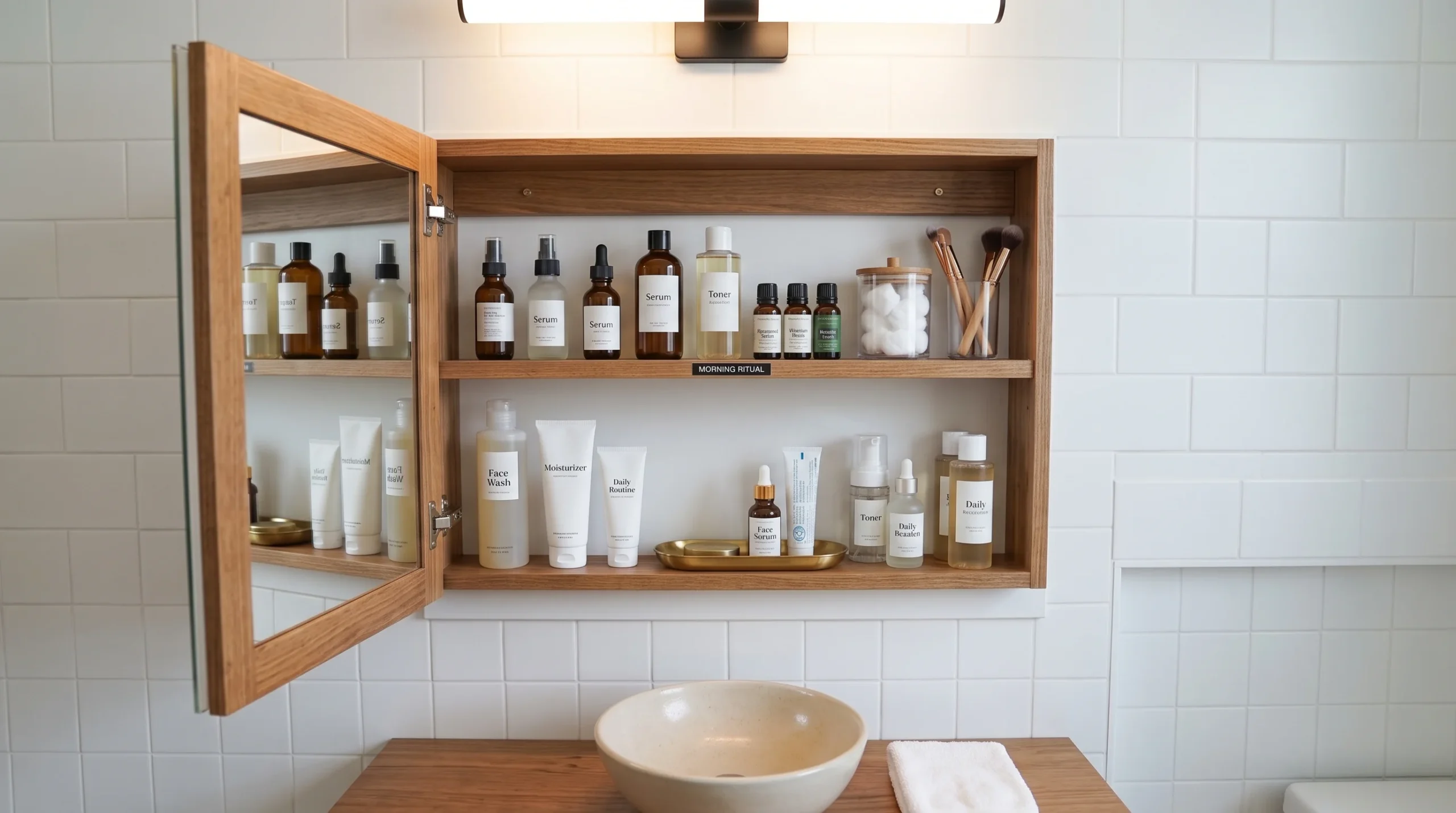
A mirror cabinet does something no other storage idea on this list can: it combines a genuine functional need, a mirror at the sink, with real storage capacity, without adding a single inch to the room’s footprint. Most people assume a medicine cabinet is a fixed feature you either have or don’t, but a surface-mounted version can be added to almost any bathroom wall near the sink, recessed or not, depending on what the wall structure allows. This is one of the more structurally involved ideas here, particularly if you want it recessed into the wall itself.
A recessed installation, which sets the cabinet flush into the wall cavity between studs, gives a cleaner, more architectural finish but requires opening the wall, so it’s worth planning during a renovation rather than as a standalone weekend project. A surface-mounted version skips that structural work entirely, adding the same storage capacity with a simple wall mount instead. Either approach solves the same core problem: giving daily-use toiletries a defined, mirrored home instead of scattering them across the counter each morning. Whichever version fits your bathroom, the storage gain is genuinely meaningful for something that occupies zero extra floor space.
Wall-Mounted Wire Baskets
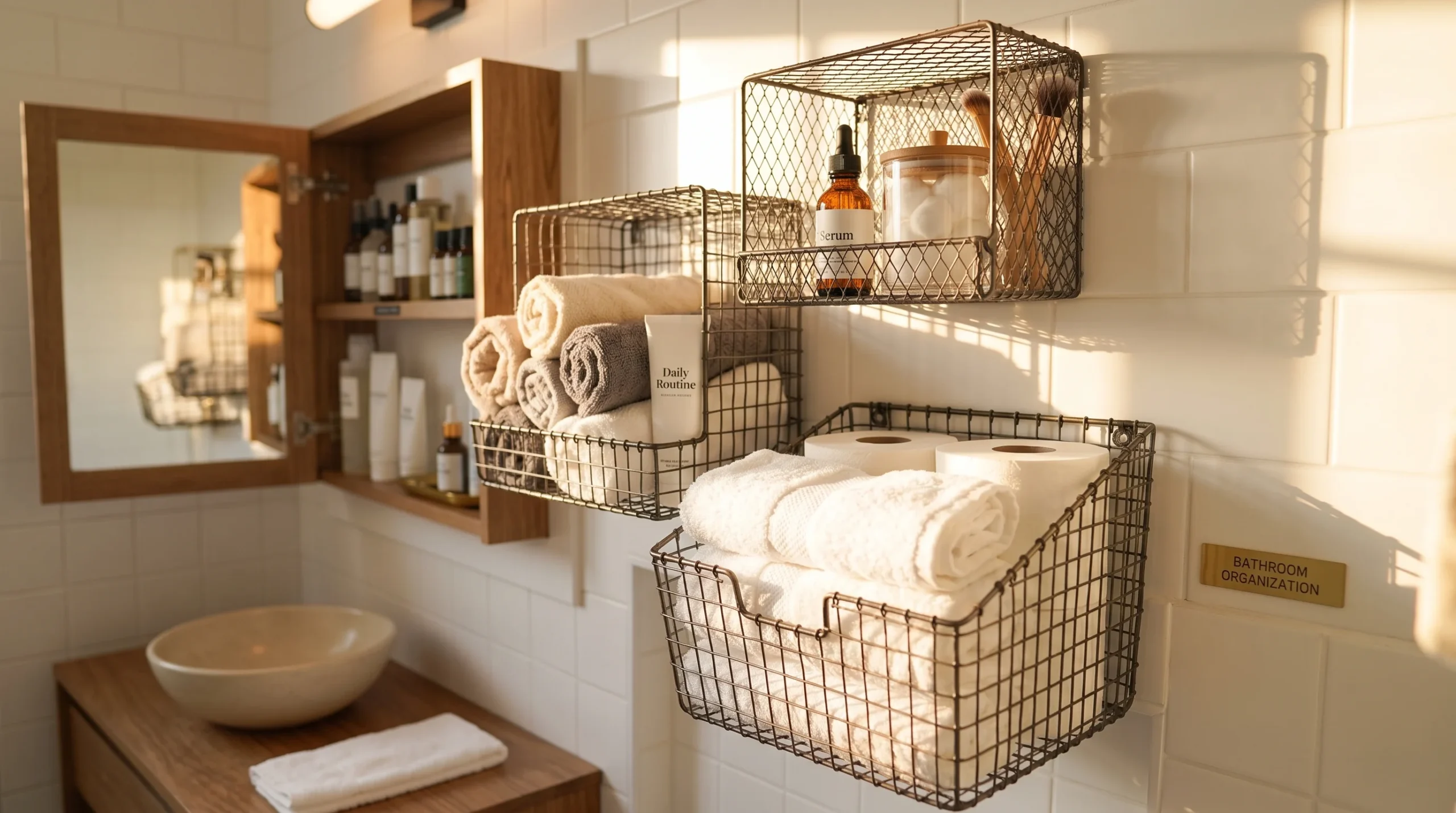
- Wire baskets mount directly to the wall, adding storage without any floor or counter footprint.
- Open mesh design lets items air dry, which matters for anything used in a humid bathroom.
- Group three baskets at varying heights for a display that reads as intentional, not random.
- Choose a finish (matte black, brass, chrome) that matches your existing bathroom hardware.
Wall-mounted wire baskets solve a specific problem that closed storage doesn’t: items stored in a humid bathroom need airflow, and a mesh basket allows exactly that in a way a solid bin or drawer never could. Mounted directly to the wall, they add real storage capacity without occupying any floor or counter space at all, which matters considerably in a bathroom where both are already scarce. This is a good structural choice for anything that gets wet regularly — bath toys, loofahs, washcloths — since trapped moisture in closed storage tends to encourage mildew over time.
Grouping three baskets at slightly varying heights, rather than in a perfectly even row, creates a more dynamic composition that reads as intentional styling rather than a random collection of hooks and hardware. Choosing a finish that matches the room’s existing fixtures — matte black, brushed brass, polished chrome — keeps the baskets feeling like part of the room’s original design rather than an obvious add-on. This is a low-cost, easily reversible way to add genuine storage in a bathroom where every wall matters more than it would in a larger room.
Door-Back Organizer
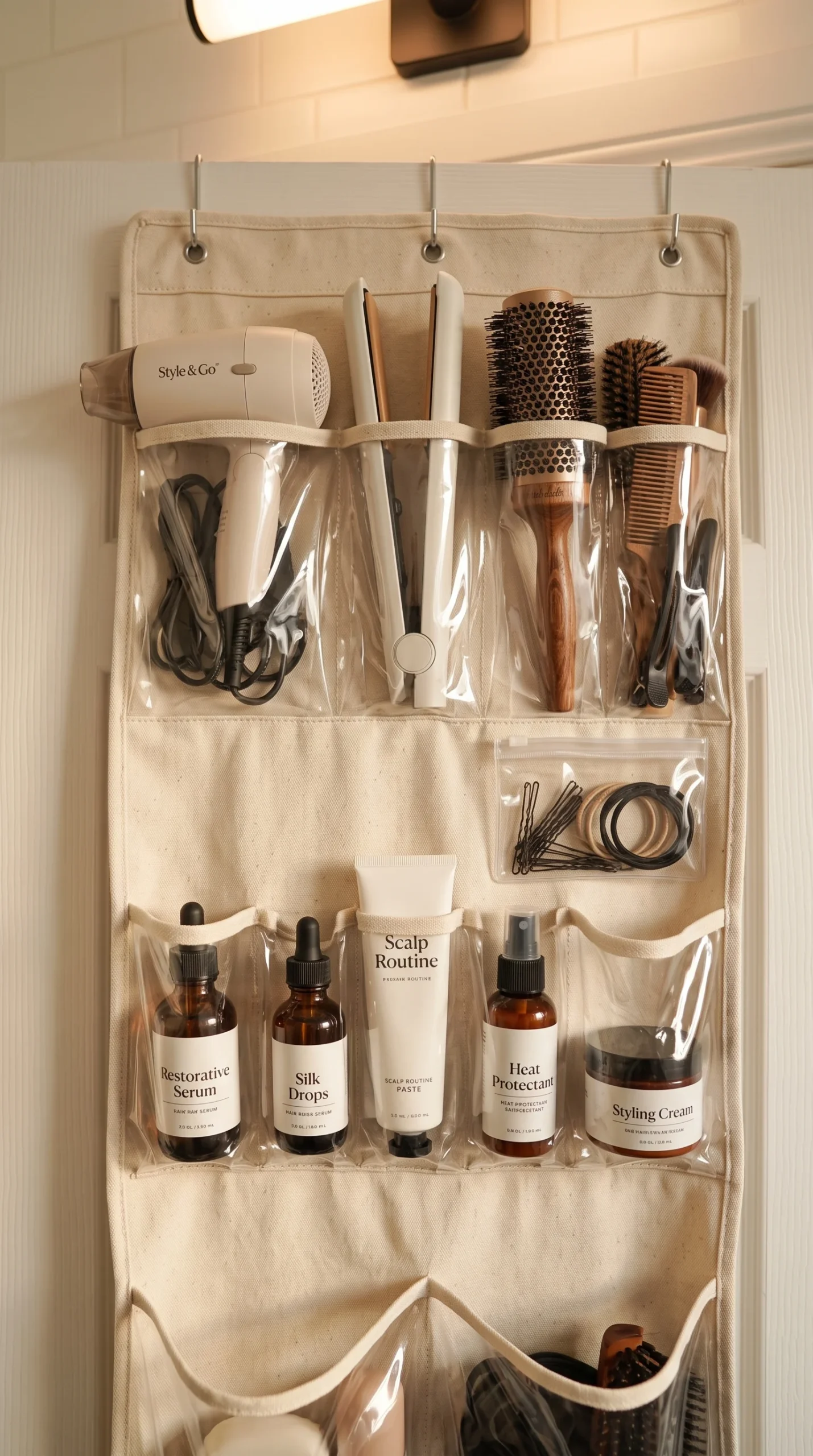
Every door in a small bathroom represents unused vertical real estate, and a door-back organizer is one of the few storage solutions that requires genuinely zero structural change to capture it. Hung directly over the bathroom door, it adds meaningful pocket storage without a single screw or anchor going into the wall or the tile, which makes it one of the most reversible ideas on this entire list — a real consideration for renters who can’t drill into a tiled bathroom wall or leave any lasting mark behind at all.
This works best for smaller, frequently grabbed items — hair tools, skincare, cleaning supplies — rather than anything bulky that would prevent the door from closing properly against the frame. A slim-profile organizer matters more than it might seem in a bathroom specifically, since a bulky one can catch on the door frame in a room that’s already tight on clearance. This is a low-cost, low-risk way to add real storage capacity without touching a single wall or committing to anything permanent, which makes it a good starting point for anyone still testing out a layout.
- A door-back organizer uses vertical door space that otherwise contributes nothing to a bathroom’s storage.
- Works well for small, frequently used items — hair tools, toiletries, cleaning supplies.
- No installation required beyond hanging the unit over the existing door, making this fully reversible.
Floating Vanity Shelf
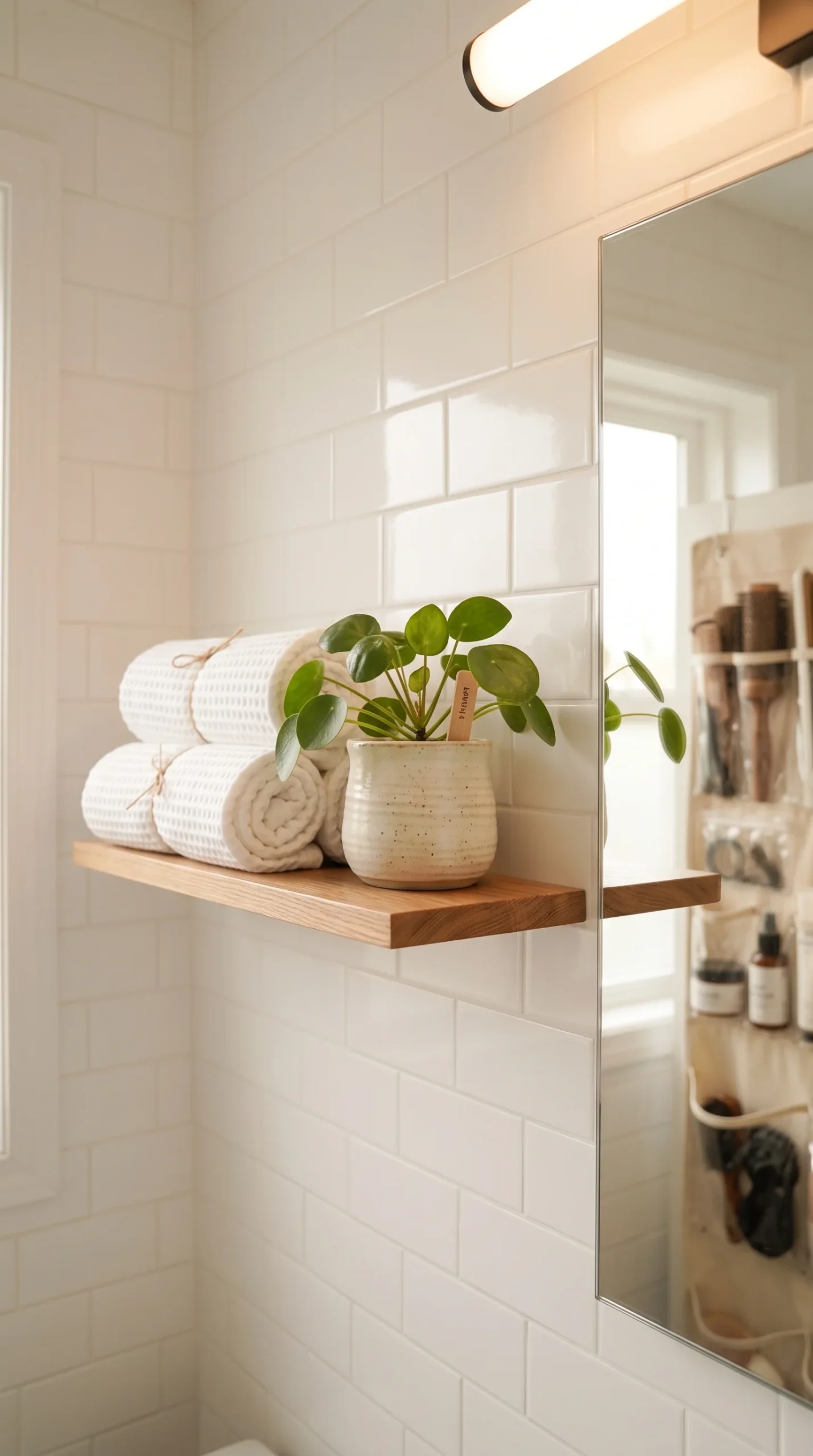
- A floating shelf adds storage beside the vanity without any visible brackets or support underneath.
- Works well for rolled towels, skincare, or a small plant to soften the room’s hard surfaces.
- Mounting into a stud, rather than tile alone, matters for anything heavier than light decor.
- A single well-placed shelf often does more visual work than several smaller, scattered pieces.
A floating vanity shelf earns its place through restraint — a single, well-proportioned shelf beside the mirror often does more for a small bathroom than several smaller pieces scattered across the wall. Because the mounting hardware is hidden, the shelf appears to float directly off the wall surface, which reads as more architectural and intentional than a bracketed alternative. This is a good example of a small addition solving both a storage need and a styling one simultaneously, without adding any visual clutter to an already tight room.
Mounting into a stud, rather than relying on tile alone, matters considerably here, especially for anything heavier than light decorative objects — tile anchors have a real weight limit that’s easy to exceed without realizing it. Styled with rolled towels, a small plant, or a few skincare bottles, this single shelf softens the bathroom’s typically hard surfaces — tile, glass, chrome — with a bit of warmth and texture the room otherwise lacks entirely. A single trailing plant or small dish works well here, since the shelf’s floating look already draws the eye without needing much to feel finished.
Tension Rod Divider
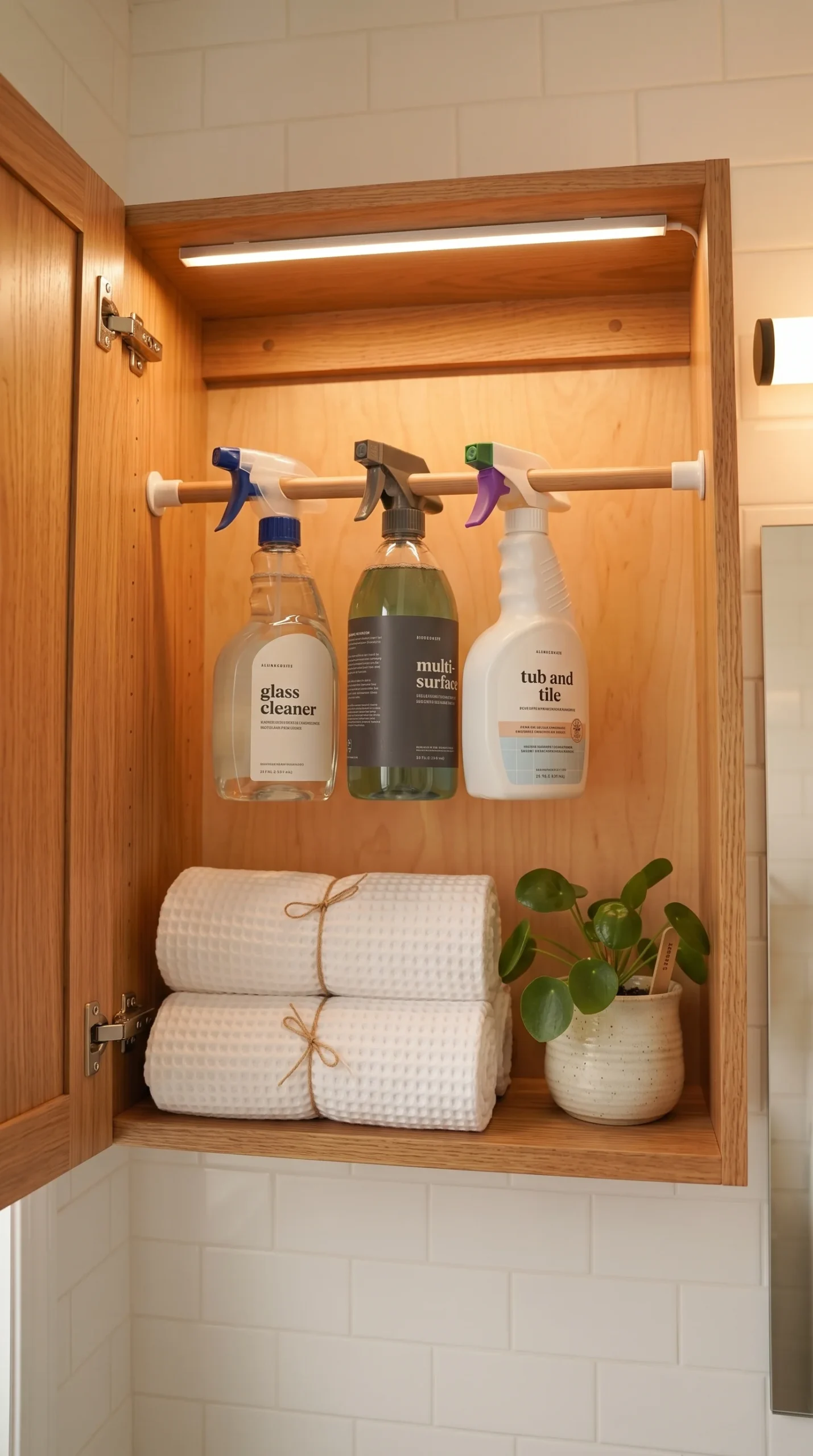
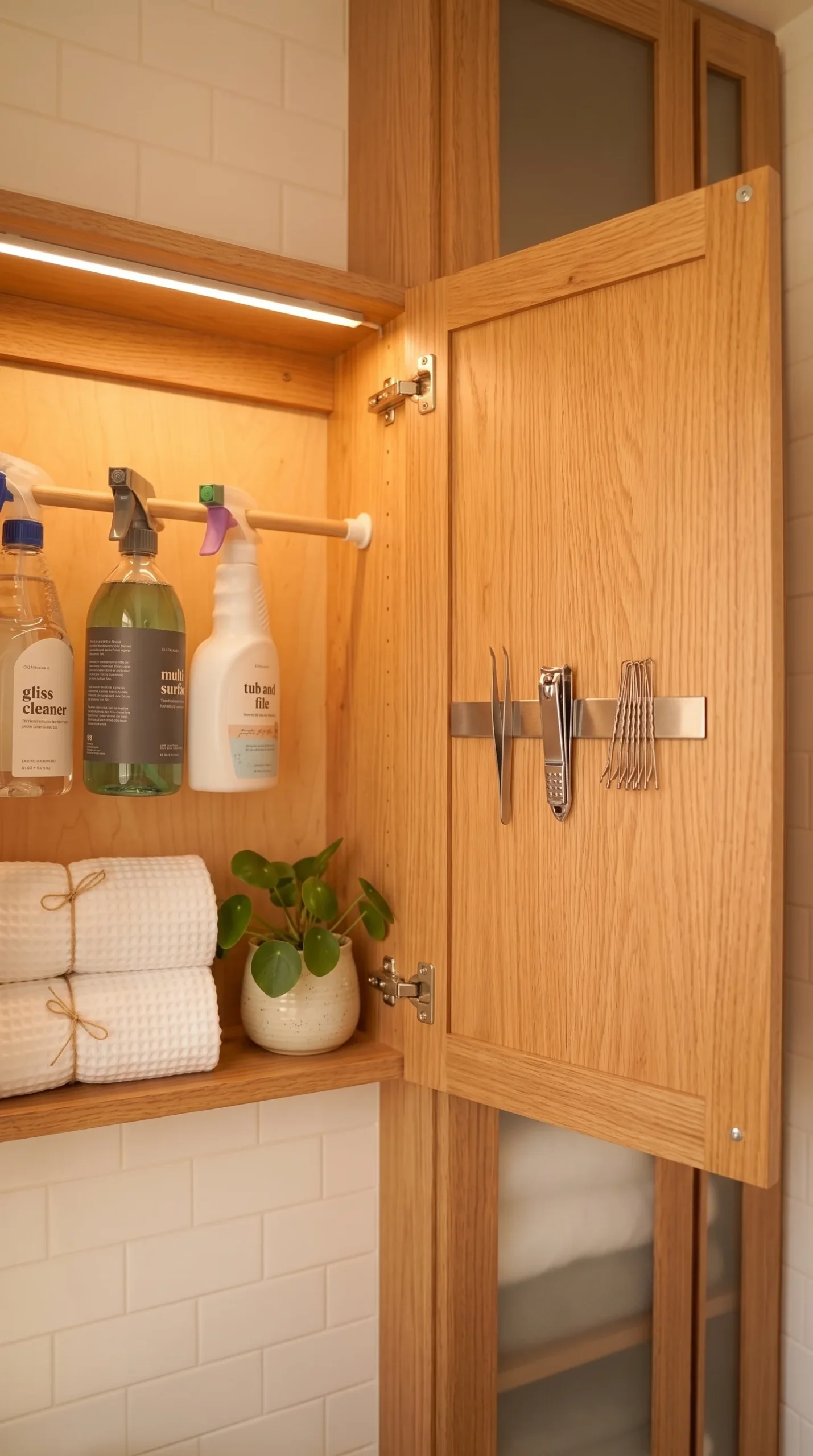
A tension rod inside a cabinet is one of the smallest, least expensive ideas on this entire list, and also one of the most structurally clever. Wedged horizontally partway up a cabinet or under the sink, it creates a second tier of storage by letting spray bottles hang by their trigger handles above whatever’s stacked below, effectively doubling the usable volume of a single shelf without adding any actual shelving. This is the kind of small-space thinking that costs almost nothing but solves a genuinely common frustration.
This works particularly well under a sink, where cleaning spray bottles otherwise take up disproportionate floor space relative to their footprint when standing upright. Suspended by the rod instead, they hang cleanly above stacked towels, extra toilet paper, or bins, freeing that floor-level space for bulkier items. It’s a genuinely small fix, but in a small bathroom, small fixes compound — a rod costing a few dollars can meaningfully change how much a single cabinet is actually able to hold on any given day, without requiring a single new shelf or bracket.
Narrow Linen Tower
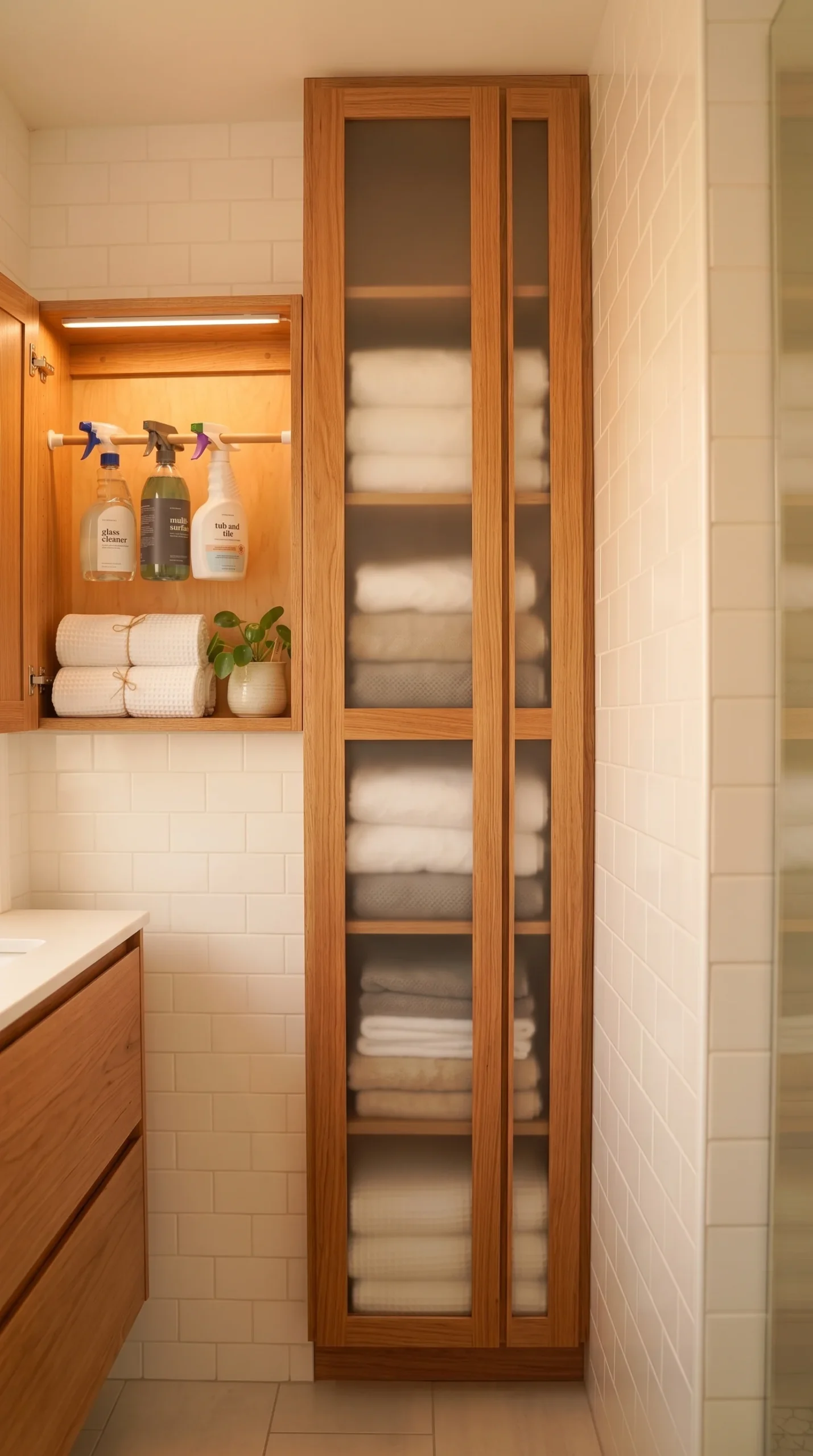
A narrow linen tower is built for exactly the kind of leftover gap most small bathrooms have and rarely use — the sliver of space beside a vanity, a tub, or a toilet that’s too slim for standard furniture but too large to simply ignore. Because these units are designed specifically around a narrow footprint, often under twelve inches deep, they fit spaces that would otherwise sit empty, adding genuine full-height storage where nothing else realistically could. This is a purchased piece rather than a structural change, which makes it one of the more accessible ideas here for renters.
Glass-paneled doors keep the contents visible without looking cluttered, which matters in a small room where every visual element either adds to or detracts from the overall sense of order. A common approach is reserving this tower specifically for towels and linens, rather than a mix of everything, since a single-purpose zone stays organized more easily than one asked to hold too many different categories at once. In a bathroom this size, that kind of discipline genuinely pays off over time, especially in a household sharing one linen zone between several people.
Magnetic Strip Storage
A magnetic strip is one of the smallest ideas on this entire list, but it solves a genuinely common frustration: small metal tools — tweezers, nail clippers, bobby pins, safety pins — that constantly get lost loose in a drawer or a cluttered tray. Mounted inside a medicine cabinet door, the strip holds these items visibly and securely, using a flat vertical surface that would otherwise sit completely empty and unused. This is a low-cost fix that punches well above its actual size in terms of daily convenience.
This works especially well for anyone who’s spent real time digging through a drawer looking for a specific small tool, since a magnetic strip makes everything visible and grabbable at a glance instead. Positioned on the inside of a cabinet door rather than an outward-facing wall, it stays out of sight when the cabinet is closed, keeping the room’s overall visual composition clean. It’s a tiny addition, but it meaningfully reduces the daily friction of a cluttered drawer full of loose metal odds and ends, and it costs less than most single bath products on the shelf beside it.
- A magnetic strip holds small metal tools — tweezers, nail clippers, bobby pins — without a tray or drawer.
- Mounted inside a cabinet door, this uses space that otherwise sits completely empty.
- Works especially well for items that are easy to lose loose in a drawer.
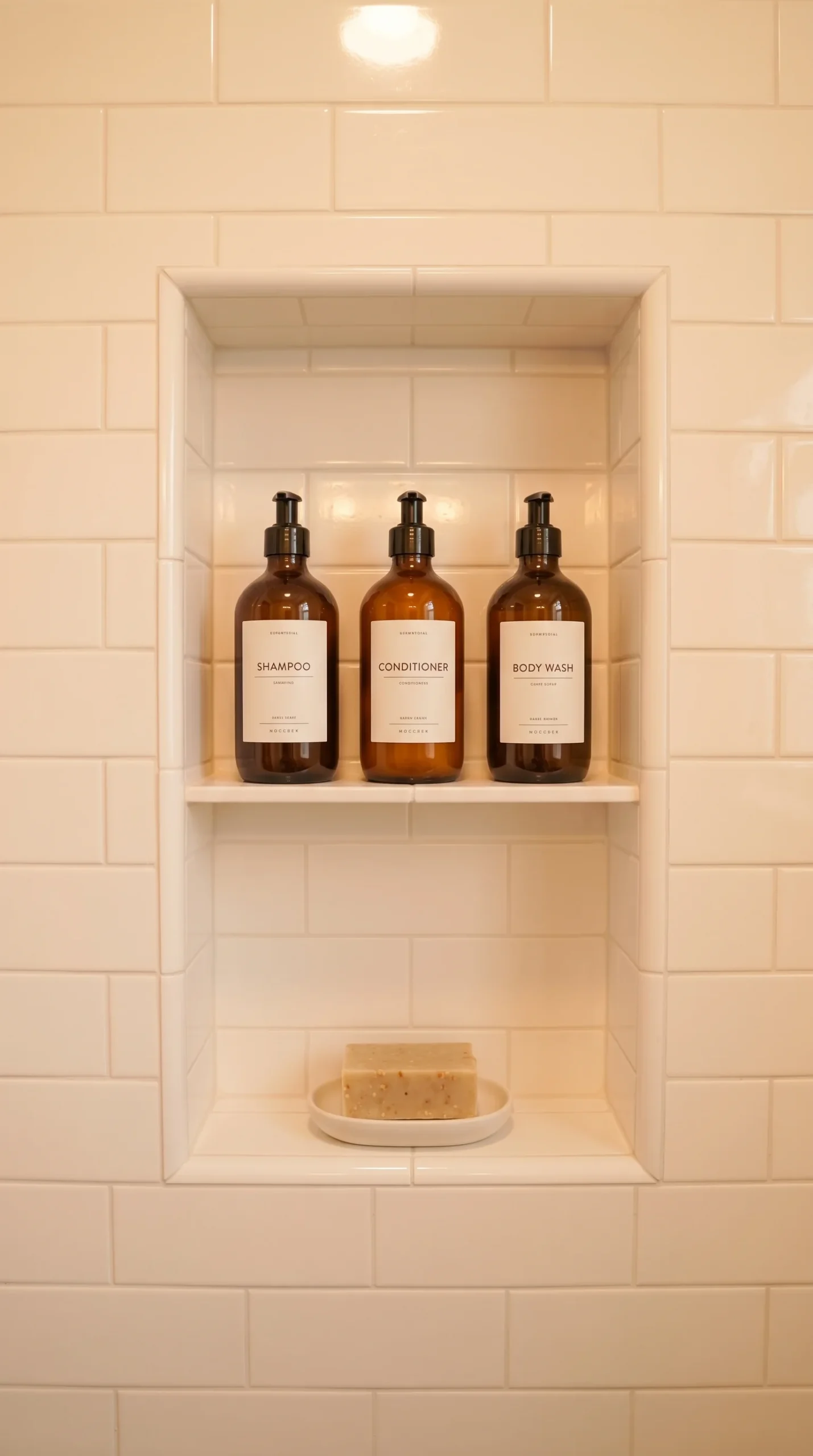
Recessed Niche Shelving
A recessed niche is the most architecturally integrated storage solution on this entire list, since it’s built into the wall’s actual structure rather than added on top of it afterward. Set flush between studs in a shower or tub wall, a niche adds genuine shelf space with zero visual footprint — nothing protrudes into the stall, and nothing interrupts the clean line of the tile. This is a renovation-level project, not a weekend fix, since it requires opening the wall during construction rather than mounting hardware onto an existing surface.
If a bathroom renovation is already planned, this is worth prioritizing early, since retrofitting a niche into a finished wall later means real demolition and retiling work that’s considerably more disruptive than building it in from the start. Two or three shallow shelves within the niche typically cover a household’s actual shower storage needs, without requiring the bulkier caddies or racks other ideas on this list rely on. Done well, it reads as though the wall was always designed around it, rather than retrofitted after the fact to solve a storage problem.
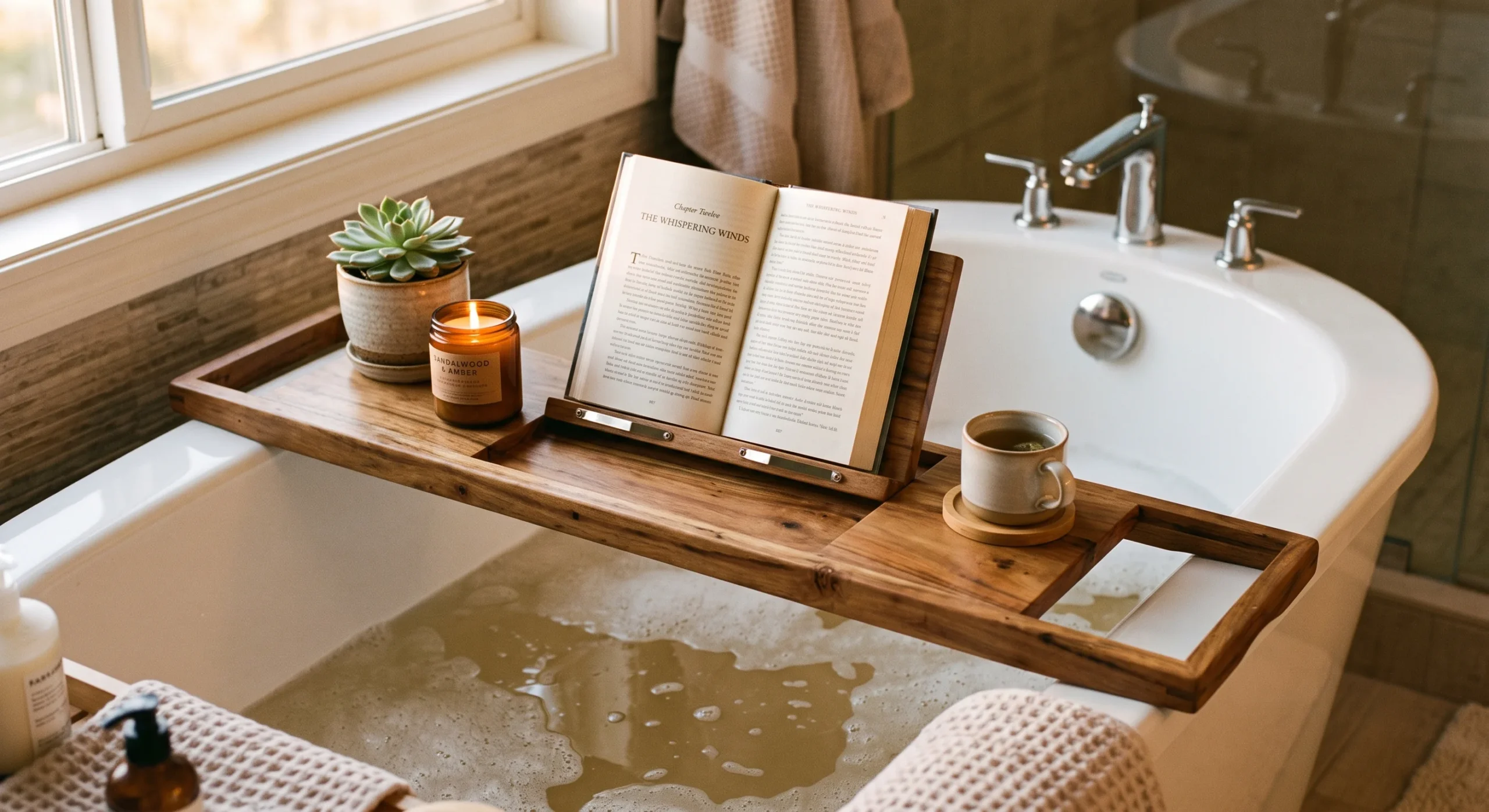
Bathtub Caddy Tray
- A caddy tray spans the tub’s width, adding a defined surface where none existed before.
- Adjustable versions fit a range of tub widths, useful if you’re unsure of exact measurements.
- Works well for a book, candle, or drink during a bath, beyond pure storage function.
- Choose a water-resistant material like teak or bamboo, which holds up better to regular moisture.
A bathtub caddy tray solves a problem that’s easy to overlook until you actually need it: a bathtub has no built-in surface at all, which means anything used during a bath either balances precariously on the edge or sits on the floor within reach. Spanning the width of the tub, a caddy tray adds a genuine flat surface exactly where one was missing, without requiring any installation or permanent change to the bathroom itself. It also keeps the tub rim clear, which matters in a small bathroom where every surface tends to collect clutter within a day or two.
Adjustable versions, which extend or contract to fit a range of tub widths, are worth the small extra cost if you’re not certain of your tub’s exact measurements beforehand. Beyond pure storage, this surface tends to get used for a book, a candle, or a drink just as often as bath products, which is part of why it earns its place on a storage-focused list. Choosing a genuinely water-resistant material like teak or bamboo matters here, since this tray sits in a consistently humid environment.
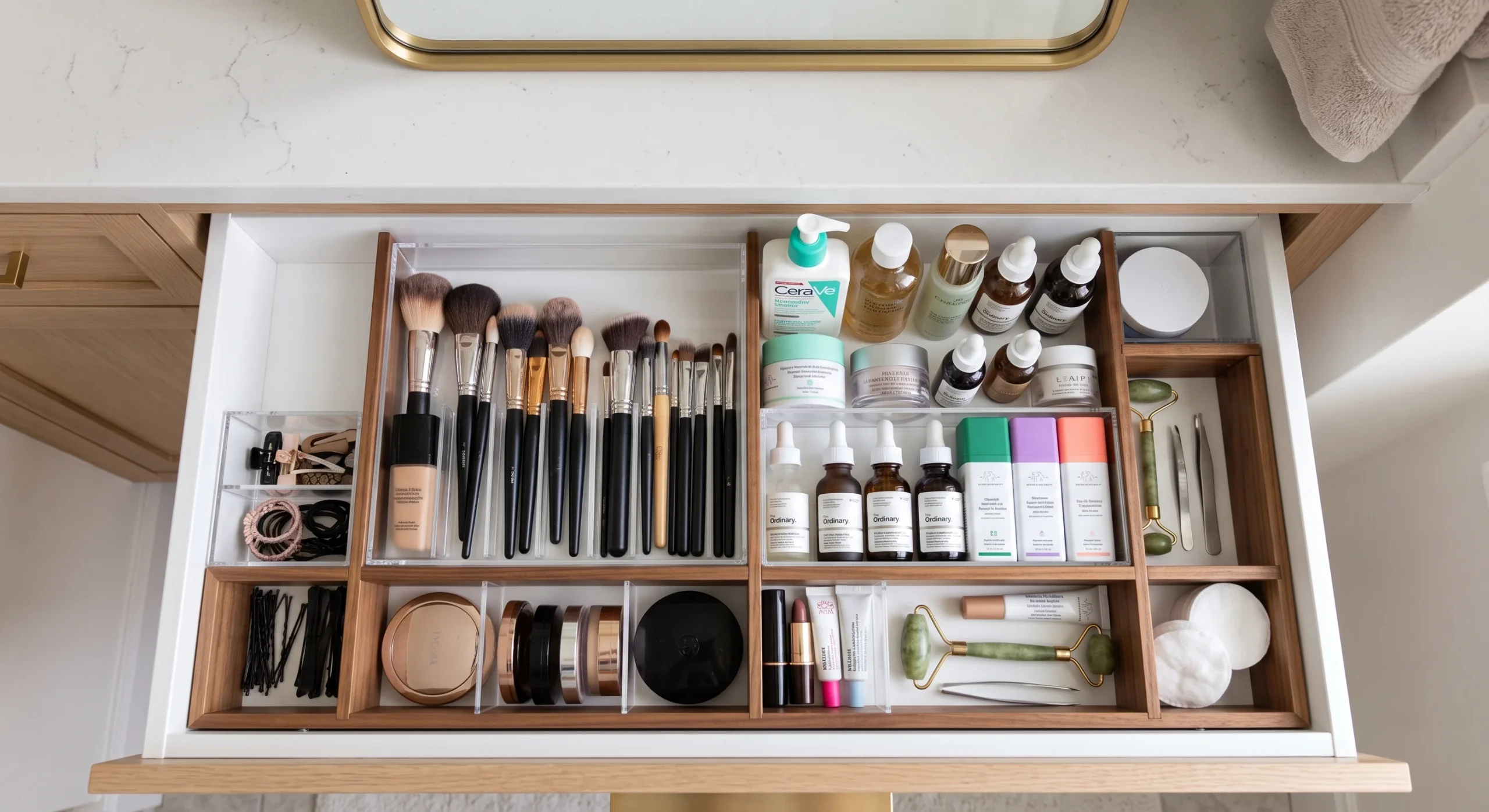
Drawer Divider Trays
- Divider trays turn one undivided drawer into several defined compartments for different item types.
- Works well for makeup, skincare, and hair accessories that otherwise slide around loose.
- Adjustable trays let you customize compartment sizes around what you actually own.
- A quick five-minute reset each week keeps the system from sliding back into clutter.
- This is one of the lowest-cost ideas on this list relative to the organization it adds.
A single undivided vanity drawer almost always becomes a junk drawer eventually, simply because nothing inside it has a defined place to actually live. Divider trays solve this directly, breaking one open space into several distinct compartments sized for makeup, skincare, hair accessories, or whatever else tends to slide around loose otherwise. This is a small, low-cost intervention, but the organizational return is disproportionate to the effort involved — a five-dollar tray can meaningfully change how a drawer functions for years, without a single hour of real effort beyond dropping it in.
Adjustable trays, with compartments that shift or reconfigure, are worth prioritizing over a fixed grid, since they let the layout adapt to what you actually own rather than forcing your items into a predetermined shape. A quick reset every week or two, just straightening what’s drifted out of place, keeps the whole system from sliding back into the clutter it was meant to solve in the first place. This is one of the lowest-cost ideas on this entire list relative to the order it actually creates.
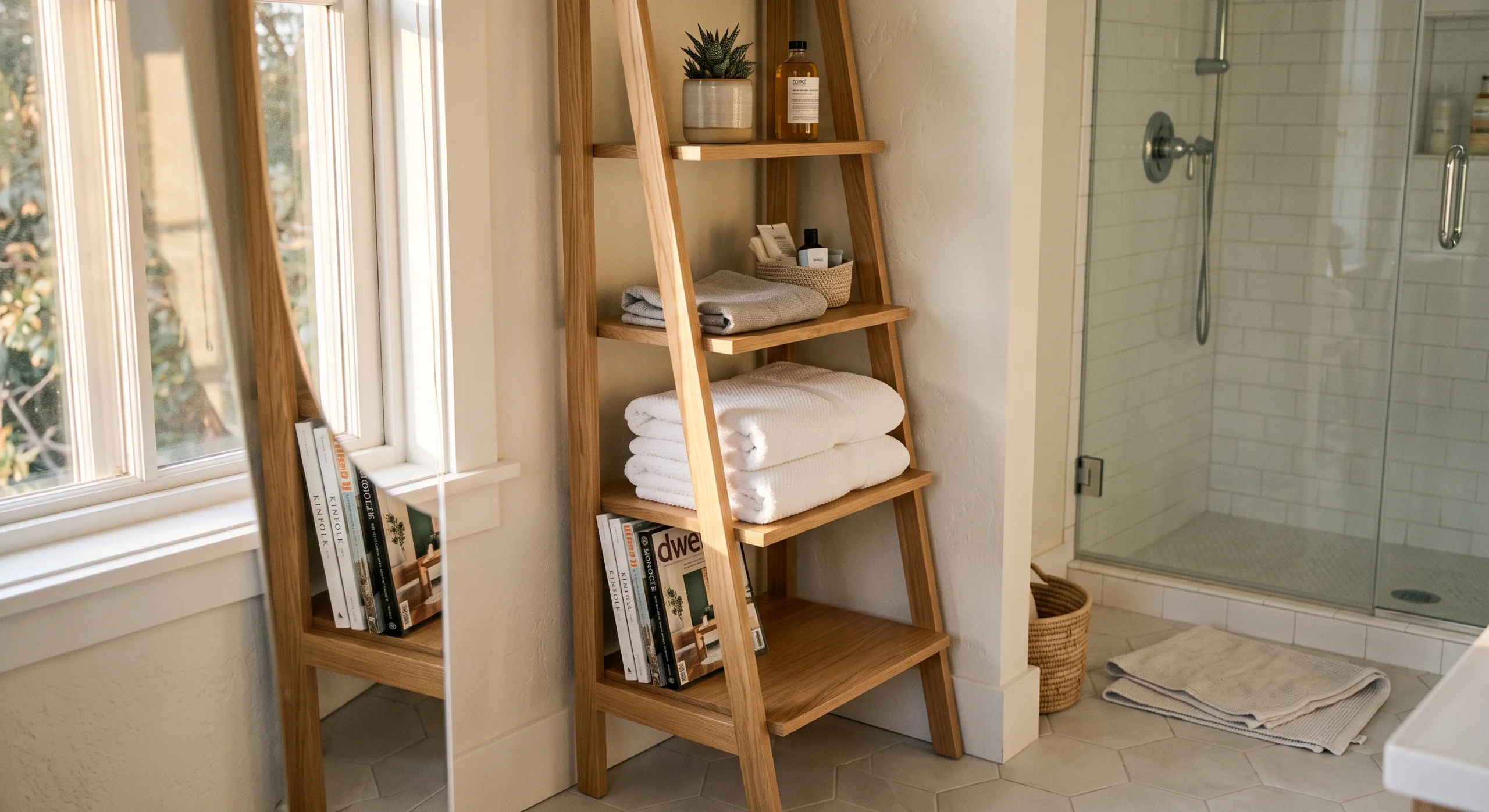
Ladder Shelf Unit
A ladder shelf unit takes the same leaning-furniture logic used elsewhere on this list and applies it directly to a bathroom corner, one of the most consistently empty zones in any small room. Because it rests on its own footprint rather than mounting to the wall, it requires zero drilling into tile, which makes it one of the fastest and least risky additions to set up in a rented bathroom. Each shelf holds towels, extra toiletries, or a small stack of reading material, turning unused corner space into genuine function.
Open shelving keeps everything visible and within easy reach during a normal morning routine, which matters in a small bathroom where digging through closed storage costs real time before work or school. This is one of the fastest ideas on this entire list to actually implement, since it involves no measuring, no drilling, and no waiting for anything to cure or dry — just positioning the unit and loading it up. It’s a simple, low-risk way to add real storage in minutes, with nothing to measure and nothing to wait on before it’s ready to use.
- A ladder shelf leans into a corner, using a zone most bathrooms leave completely empty.
- Open shelves keep towels and essentials visible and easy to grab during a morning routine.
- This requires zero installation, making it one of the fastest ideas on this list to set up.
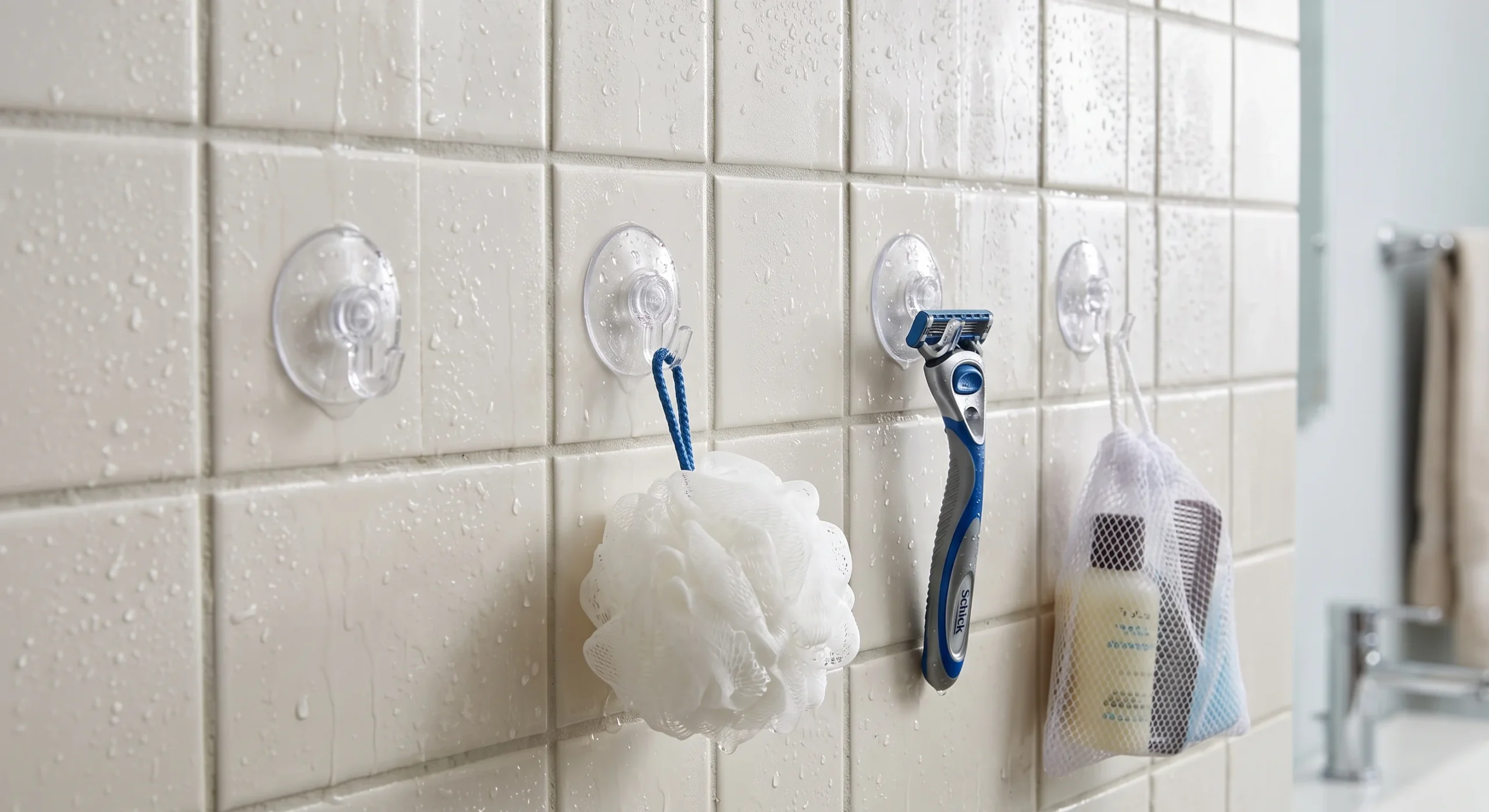
Suction Cup Hooks
- Suction cup hooks stick directly to tile or glass, needing no drilling or adhesive at all.
- Works well for lightweight, frequently used items — loofahs, razors, small mesh bags.
- Reposition freely as your routine changes, since hooks lift off and reattach easily.
- Choose a genuinely strong suction rating for anything that gets bumped or pulled regularly.
Suction cup hooks are the lowest-commitment storage idea on this entire list, sticking directly to tile or glass through vacuum pressure alone, with no drilling, no adhesive, and no permanent mark left behind. In a shower or beside a sink, they hold lightweight, frequently used items — a loofah, a razor, a small mesh bag — exactly where they’re needed, rather than balanced precariously on a shelf edge or the tub rim. This is a genuinely reversible solution, which makes it a safe starting point for anyone unsure what their bathroom actually needs yet.
Because they lift off and reattach easily, hooks can be repositioned freely as your routine changes, without leaving any residue or damage on the tile or glass underneath. Choosing a hook with a genuinely strong suction rating matters for anything that gets bumped, pulled, or leaned on regularly, since a weak or cheap version tends to fail exactly when it’s holding something you don’t want to drop onto tile or glass below, usually mid-shower. A quick wipe of the tile before attaching one makes a real difference to how long it holds, since leftover soap residue is usually why a suction cup fails early.
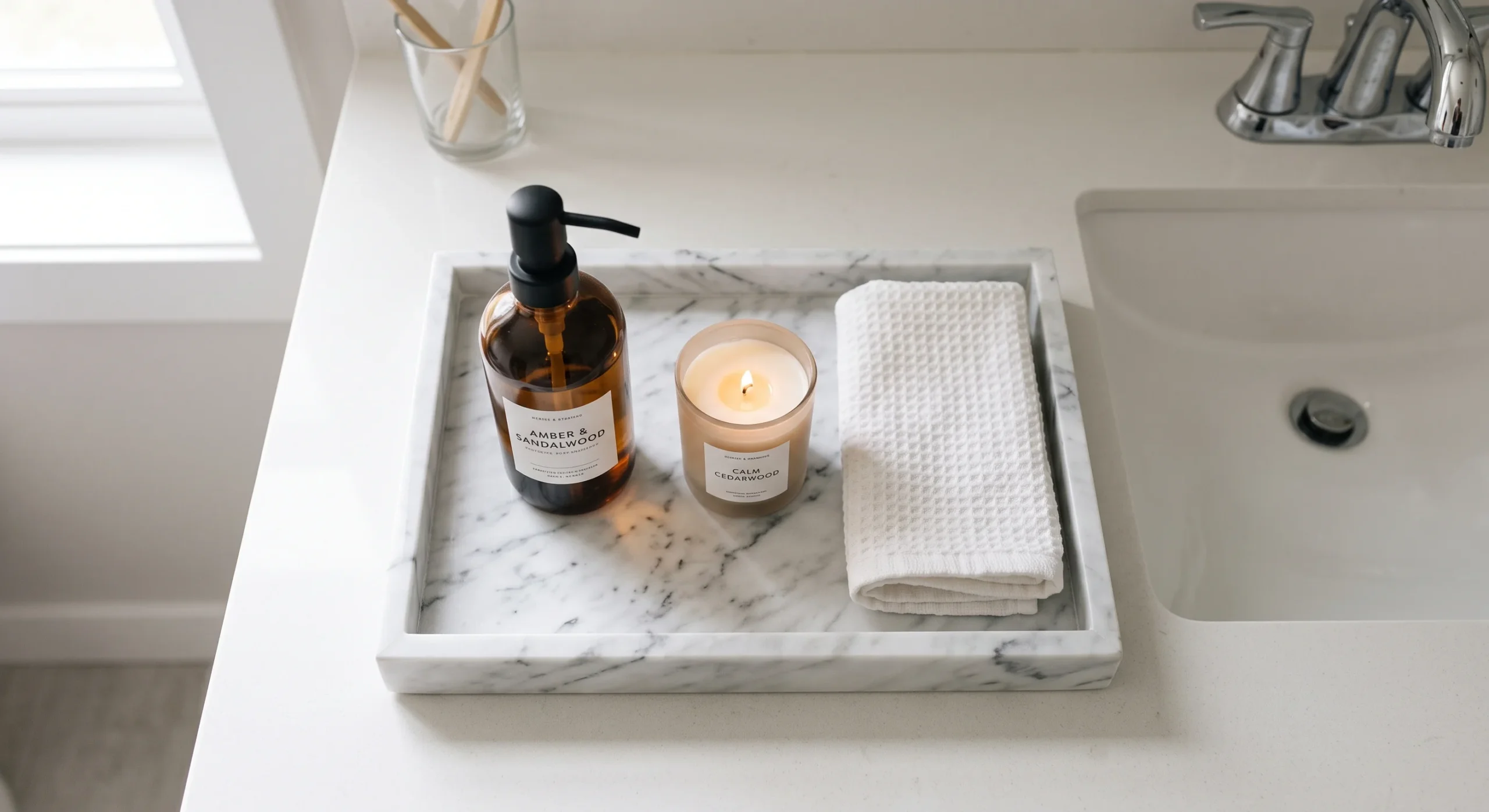
Countertop Tray Organizer
A countertop tray solves a problem that has nothing to do with actual storage capacity and everything to do with visual order: loose items scattered across a counter read as clutter, while the exact same items contained within a tray read as intentional styling. This is one of the simplest ideas on this entire list, requiring no purchase beyond the tray itself and no installation of any kind, just a defined boundary for whatever already lives on the counter each day, corralling it into one visually calm zone instead of a scattered mess.
This works especially well for daily-use items — a soap dispenser, hand lotion, a small dish for jewelry removed before washing up — that need to stay accessible rather than tucked into a drawer or cabinet. Wiping down one contained tray is also considerably faster than cleaning an entire scattered countertop, which matters in a small bathroom where the counter tends to double as a catch-all surface. It’s a small change, but it meaningfully shifts how organized the whole room feels at a glance, even before anything else on this list gets touched.
- A tray contains loose counter items within a defined boundary instead of letting them spread.
- Works well for daily-use items — soap, lotion, a small tray of jewelry.
- Wiping down one tray is faster than cleaning an entire scattered countertop.
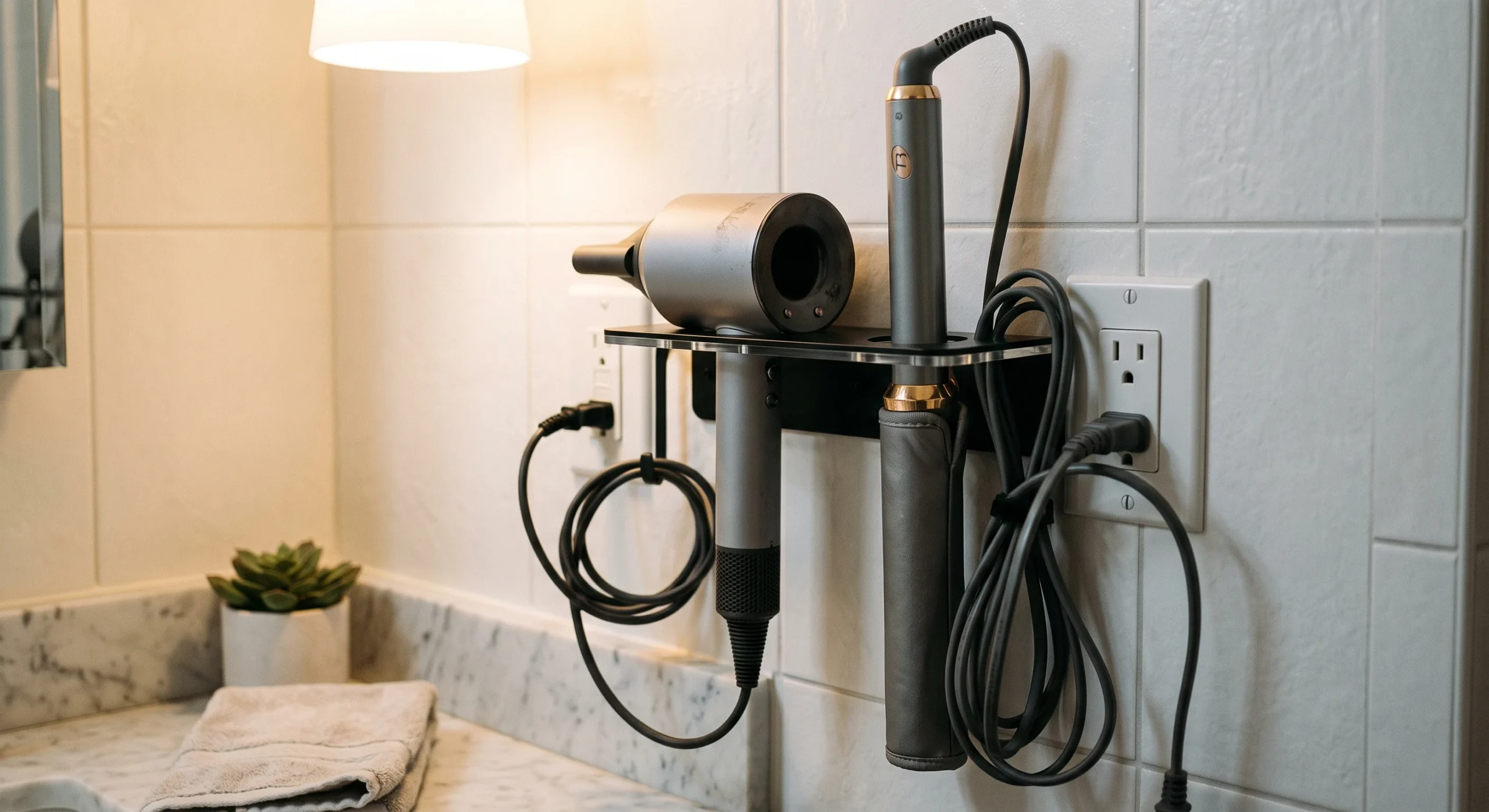
Wall-Mounted Hair Tool Holder
- A wall-mounted holder gets bulky hair tools off the counter and drawer space entirely.
- Heat-resistant materials matter here, since tools are often stored while still warm.
- Positioned near an outlet, this keeps tools within reach of where they’re actually used.
- Frees up meaningful drawer space that would otherwise be dominated by one or two bulky items.
Hair dryers and curling irons are disproportionately bulky relative to how often they’re actually used daily, and they tend to dominate whatever drawer or counter space they’re stored in as a result. A wall-mounted holder gets these tools off the counter entirely, relocating them to vertical wall space near the outlet where they’re actually used, which is exactly the kind of trade a small bathroom benefits from most, given how tight both drawer and counter space already are. Positioning it at a comfortable height, rather than tucked into a high corner, makes the difference between a holder that gets used and one that gets ignored.
Heat-resistant materials matter considerably here, since tools are often put away while still warm from recent use, and a standard plastic holder can warp or degrade under that repeated heat exposure over time. Positioned near an outlet rather than across the room, this keeps tools genuinely within reach of where they’re used, removing the daily friction of walking a hot styling tool somewhere else to store it. The drawer space this frees up is often significant, given how much room these tools typically occupy relative to almost anything else stored in the same drawer.
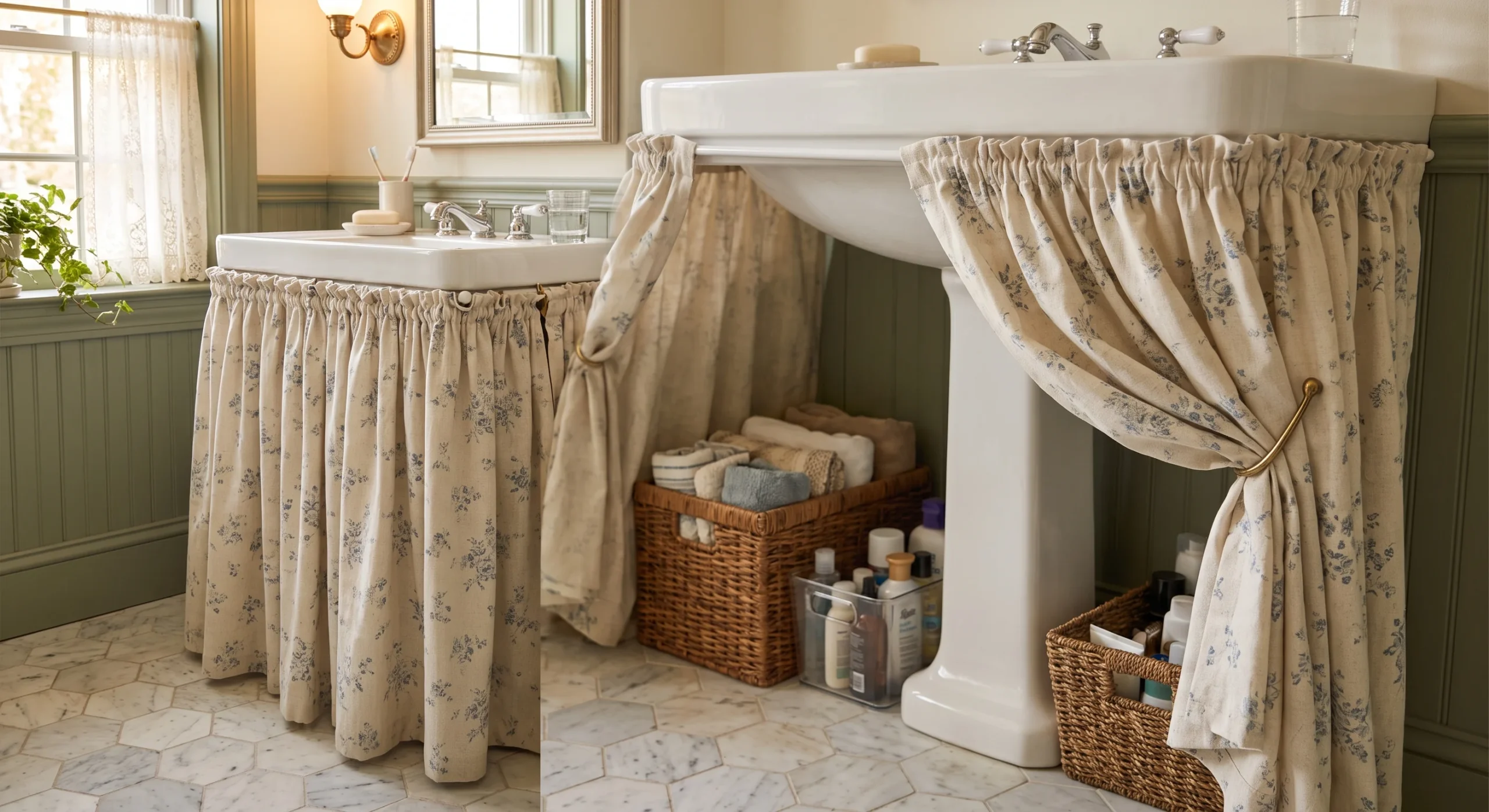
Pedestal Sink Skirt
A pedestal sink skirt closes out this list because it solves a problem unique to a specific bathroom fixture: a pedestal sink, unlike a vanity, offers no storage at all beneath it by default, just open plumbing and empty floor space. A fitted fabric skirt conceals that open area, turning it into a hidden storage zone for bins or baskets while also softening the room’s visual line, since exposed pedestal plumbing rarely looks intentional. This is a purely cosmetic and organizational fix, requiring no plumbing or structural work whatsoever.
A common approach is using two or three small baskets behind the skirt for items you want accessible but don’t need visible — cleaning supplies, extra toilet paper, spare toiletries — closing off the contents from the room’s overall sightlines entirely. Choosing a fabric that coordinates with the room’s existing palette keeps this from reading as an obvious cover-up and instead as a deliberate design choice. It’s a simple, inexpensive way to add real storage to a fixture that was never designed to offer any.
FAQ
Do I need to drill into tile for most of these storage ideas?
No — several ideas here, like tension-mounted caddies, suction cup hooks, and leaning ladder shelves, need zero drilling into tile at all. Save the drilled or recessed options for anything you’re planning to keep long-term, or for a bathroom you own outright.
What’s the single best storage idea for a bathroom with almost no counter space?
Over-toilet shelving and a floating vanity shelf together tend to make the biggest difference, since both add real storage without using any counter or floor area. Pairing those with a magnetic strip inside a cabinet door covers most of what a crowded counter is usually holding.
Are recessed niches worth the extra cost and construction work?
If a renovation is already happening, yes — building a niche in during that work adds real storage with zero visual footprint once tiled. If your bathroom isn’t being renovated, a corner caddy or ladder shelf solves a similar problem without opening a wall.
When should I bring in a professional instead of doing this myself?
Anything involving opening a wall, like a recessed niche or a surface-mounted medicine cabinet in a load-bearing wall, is worth a professional opinion before you start — you can book a consultation directly at https://wa-associates.com/book-a-consultation/ to talk through what your specific bathroom’s structure can support. Most of the ideas on this list, though, are genuinely manageable without one.
Conclusion
A small bathroom feels calm the moment every item finally has a defined place to live, and that’s really what these small bathroom storage ideas are built to deliver. From a five-dollar tension rod to a fully recessed niche, each idea solves a specific version of the same problem — too little space, asked to do too much. Start with whichever zone frustrates you most on a daily basis, not necessarily the first idea on this list. Save this roundup to Pinterest, try one change this weekend, and share it with anyone else working with a bathroom that feels smaller than it should.