
Finding genuine screen time alternatives for kids that they’ll actually ask for again isn’t as hard as it feels on a tired weekday afternoon. In my years of teaching, I’ve noticed the activities that stick aren’t the ones dressed up as “educational” — they’re the ones that feel like play while quietly building real skills underneath. This list gathers nineteen classroom-tested ideas that work with everyday materials, most already sitting in your kitchen or junk drawer. Each one is chosen for genuine engagement, not just distraction, so you get a calmer household and a child who’s actually learning something along the way.
Start Here: Kitchen Science Experiments
This is the easiest entry point because it uses ingredients most kitchens already have, needs no prep the night before, and reliably holds a child’s attention longer than almost anything else on this list.
Kitchen Science Experiments
- Baking soda and vinegar reactions teach cause-and-effect science without any special equipment needed.
- Measuring ingredients builds real math practice — fractions, volume, counting — inside a genuinely fun activity.
- Most experiments take under fifteen minutes, which fits easily into a busy weekday afternoon.
- Letting kids predict what will happen first builds the same hypothesis-forming skill real scientists use.
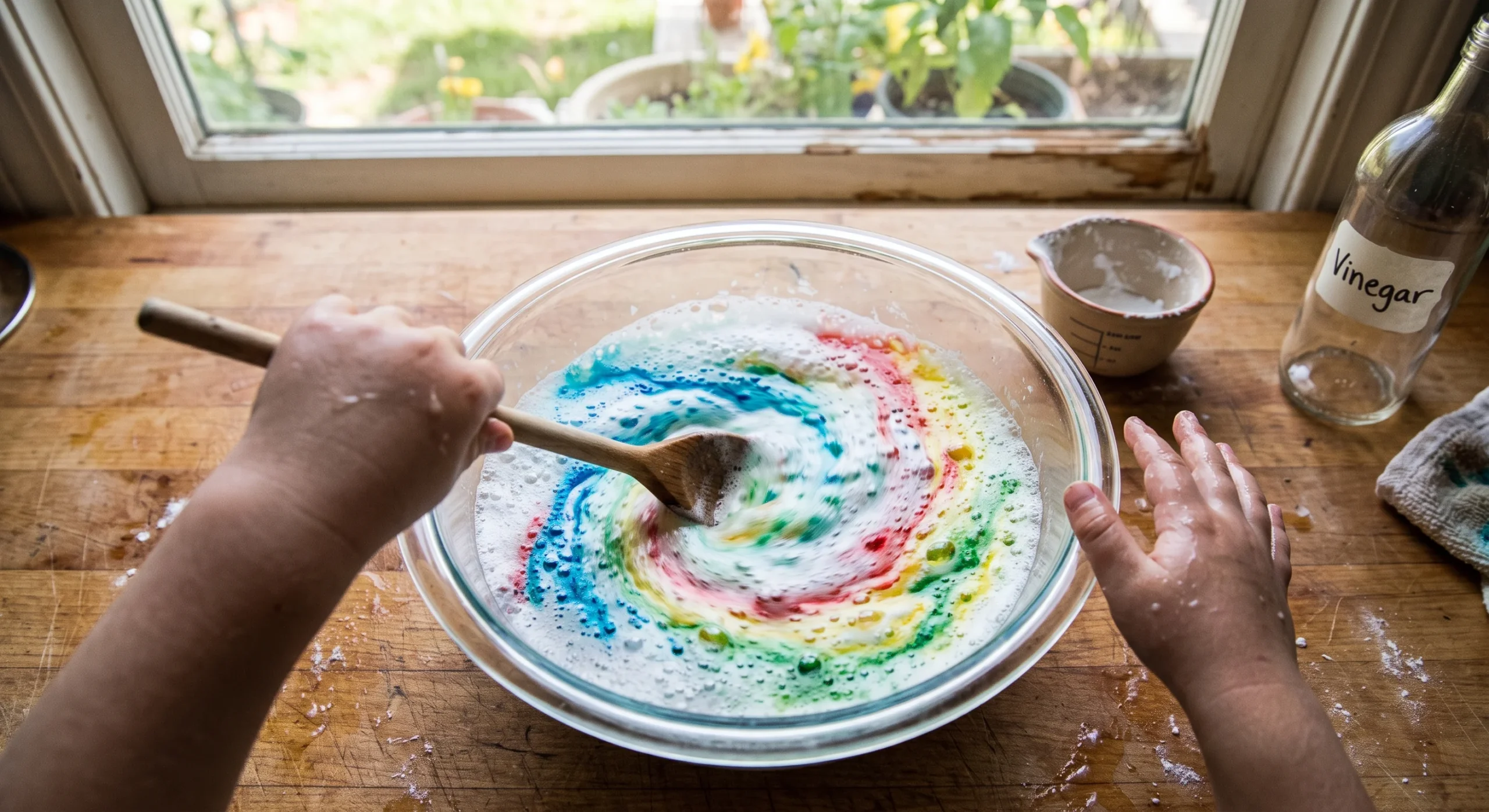
Kitchen science experiments work because they turn ordinary pantry items into something that genuinely surprises a child, and that surprise is what makes the learning stick. In my years of teaching, the lessons students remembered months later were almost always the hands-on ones, not the ones read from a worksheet. A simple baking soda and vinegar reaction, a homemade volcano, or a sink-or-float sorting game all deliver that same moment of genuine wonder, using ingredients that are probably already sitting in your kitchen cabinet right now.
Measuring cups and spoons quietly build real math skills alongside the science, since a child following a recipe-style instruction list is practicing counting, fractions, and sequencing without realizing it’s a lesson at all. Asking “what do you think will happen?” before starting each experiment builds the same predicting-and-testing habit that scientists use professionally. This is a genuinely easy one to keep in regular rotation, since the setup rarely takes more than a few minutes and the cleanup is just as simple, even on a weeknight before dinner.
Nature Scavenger Hunt
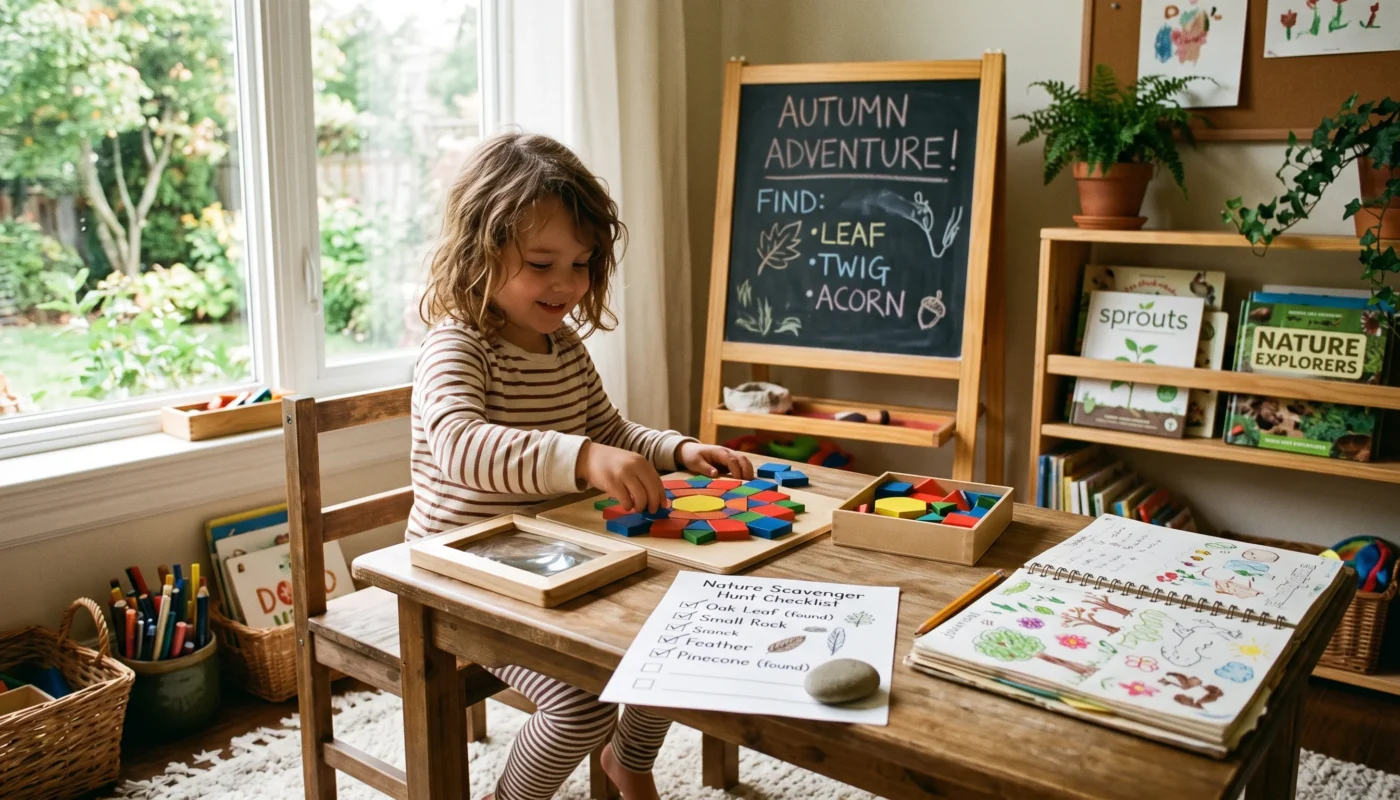
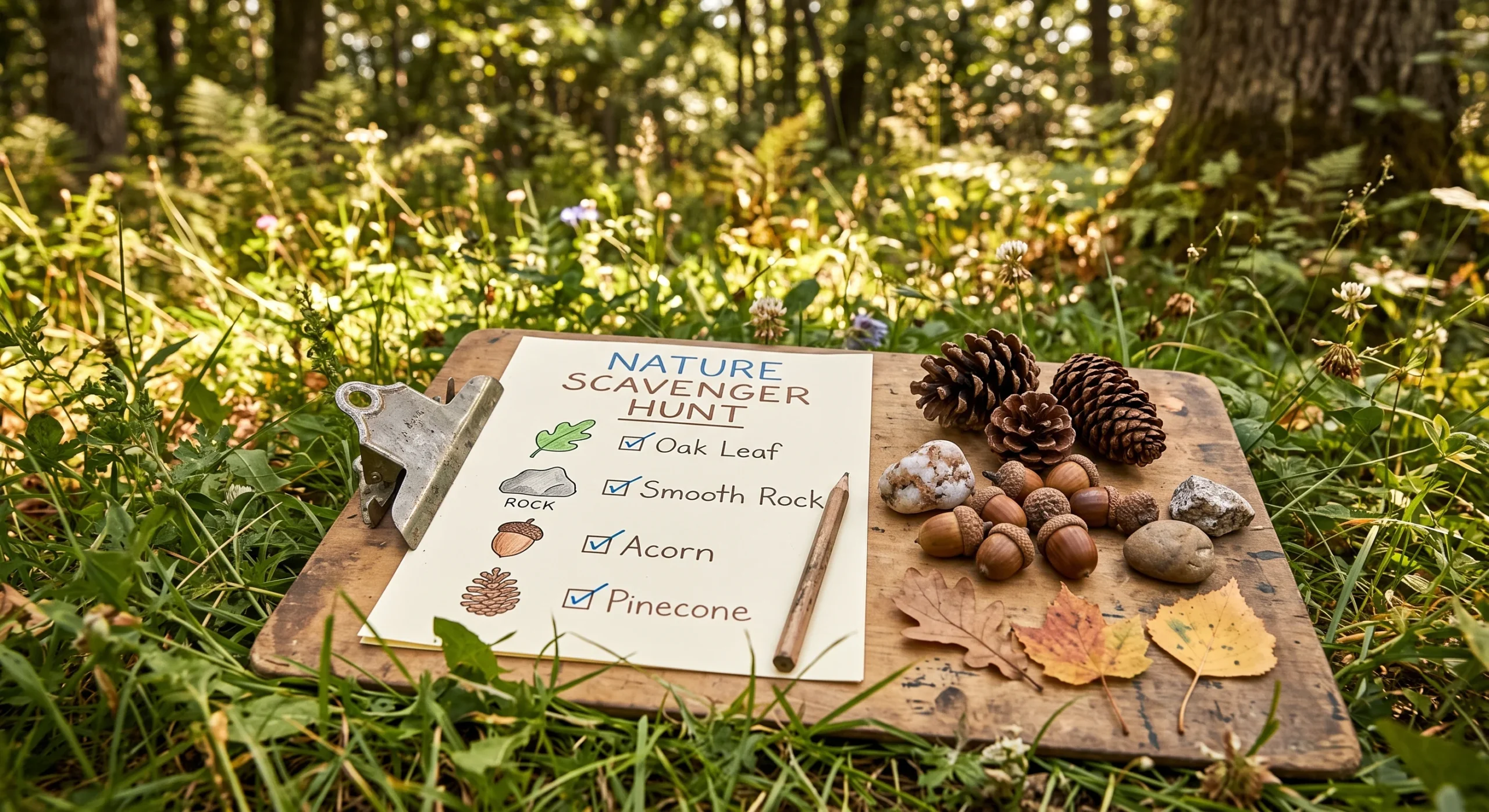
A nature scavenger hunt takes something families already do — a walk around the block or through a park — and adds just enough structure to turn it into genuine learning. A simple checklist with a handful of items to find (a smooth rock, a yellow leaf, something that makes a sound) gives a walk real purpose without feeling like schoolwork disguised as fun. This tends to work well across a wide age range, since the same walk can flex to match whatever level of detail each child is ready for that day.
Sorting the collected items afterward by color, size, or shape builds early classification skills, the same foundational thinking that later supports both science and math. A common approach is keeping a small basket by the door specifically for these finds, so the collection can grow naturally over several walks rather than needing to happen all at once. This is a genuinely low-effort activity for a parent, since most of the actual work happens outdoors, on its own, without much guidance required beyond the walk itself.
- A simple checklist of leaves, rocks, and bugs turns an ordinary walk into a genuine learning activity.
- Categorizing found items by color, shape, or size builds early sorting and classification skills.
- This works well for a range of ages at once, since younger kids can simply collect while older ones categorize.
Storytelling Dice Games
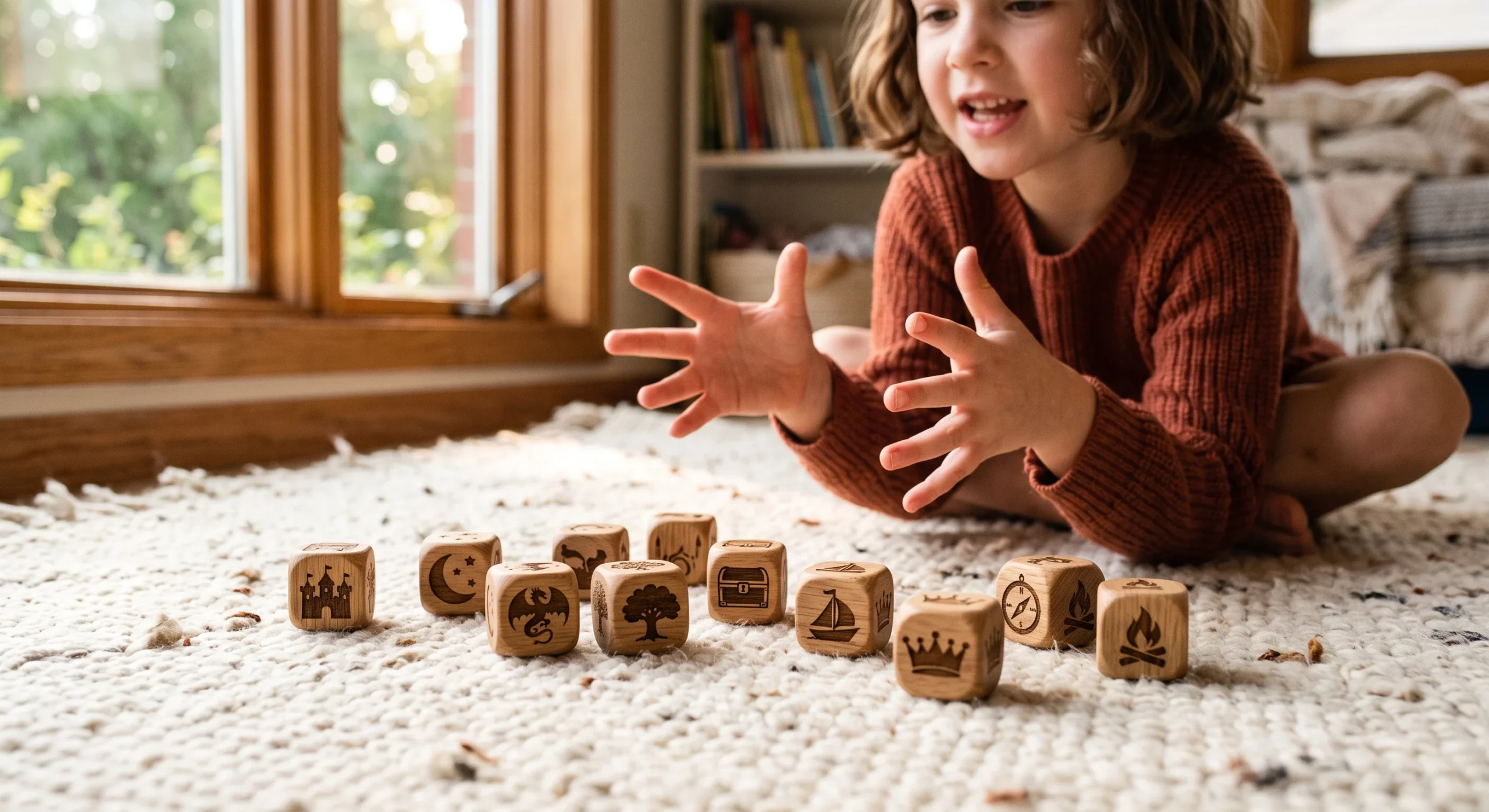
Storytelling dice — small cubes printed with simple pictures instead of numbers — turn an empty afternoon into a genuine language-building exercise disguised entirely as play. Rolling a handful and asking a child to weave whatever images come up into one connected story builds narrative sequencing, vocabulary, and confident verbal expression, all at once, without a single worksheet involved. This is a trick I used constantly in my own classroom on rainy indoor-recess days, and it translates just as well to a living room floor on a weekend afternoon.
What makes this genuinely effective is how much it rewards imperfection — there’s no wrong story, no correct answer to get to, which takes real pressure off a child who might otherwise feel hesitant to speak up. Older siblings can take turns adding to a younger child’s story, building both listening skills and collaborative thinking in the same activity. A simple set of picture dice costs very little and gets used again and again, since the combinations essentially never repeat the same way twice, keeping the game genuinely fresh.
Building Block Challenges
- Timed or themed building challenges add just enough structure to turn free play into focused problem-solving.
- Tower-building specifically teaches early physics concepts — balance, weight distribution, structural stability.
- Printed challenge cards (tallest tower, strongest bridge) keep the activity fresh without new materials needed.
- Works well solo or as a sibling competition, depending on what the moment calls for.
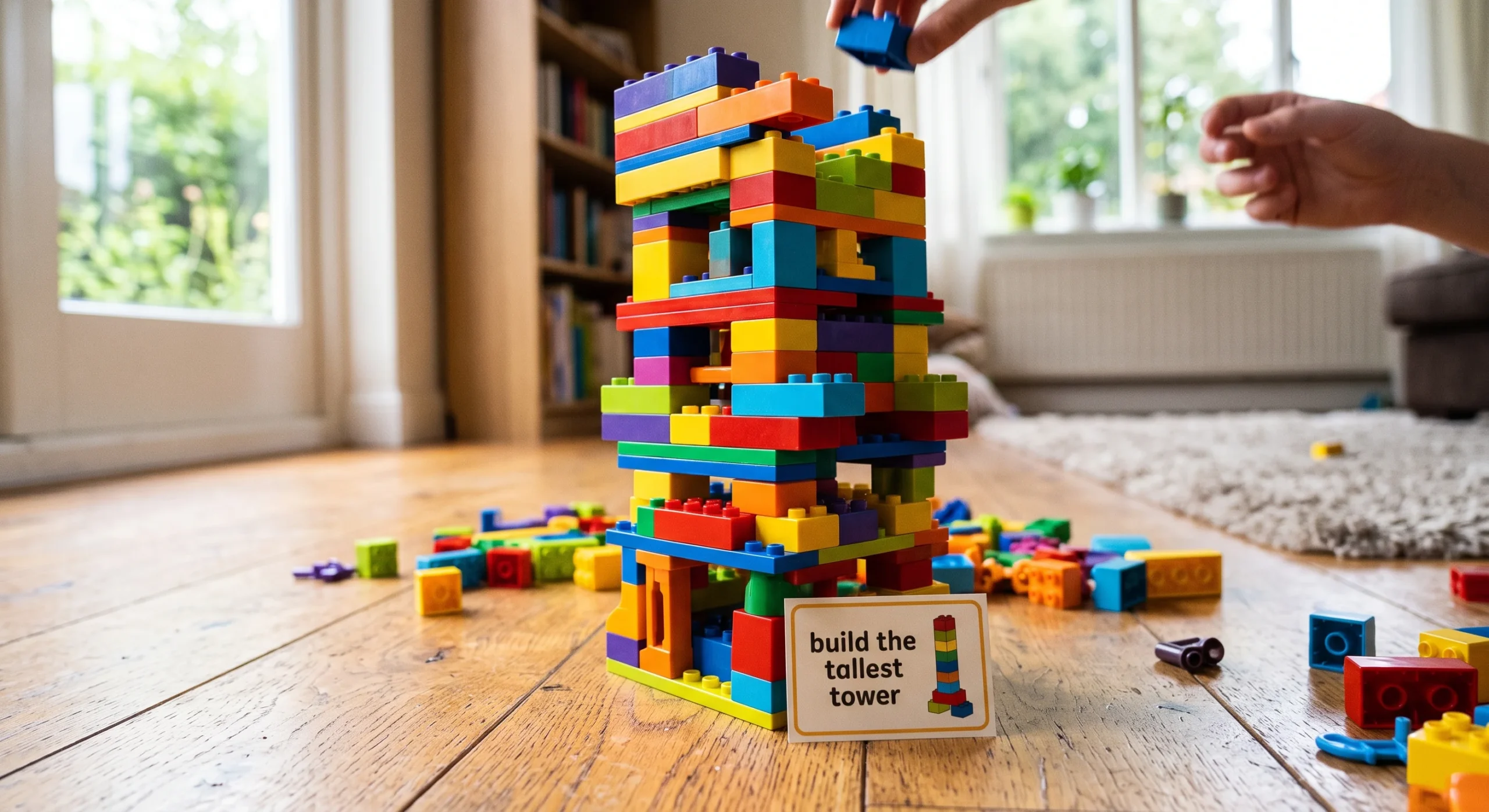
Building blocks are already a familiar toy in most homes, but adding a specific challenge — build the tallest tower that can stand for ten seconds, or the strongest bridge between two chairs — turns open-ended play into focused, purposeful problem-solving. This small structural shift matters more than it seems: a child working toward a defined goal engages differently than one simply stacking blocks without direction, testing ideas and adjusting when something falls rather than just building aimlessly with no real end goal in mind.
Tower and bridge challenges specifically introduce real physics concepts — balance, weight distribution, structural stability — long before a child could ever define those words, which is exactly how the best early science learning tends to work. A stack of printed challenge cards, swapped out every so often, keeps the activity feeling fresh without requiring any new toys or materials at all. This works equally well as a quiet solo activity or a genuinely fun sibling competition, depending entirely on the day and the mood in the house.
Sidewalk Chalk Math
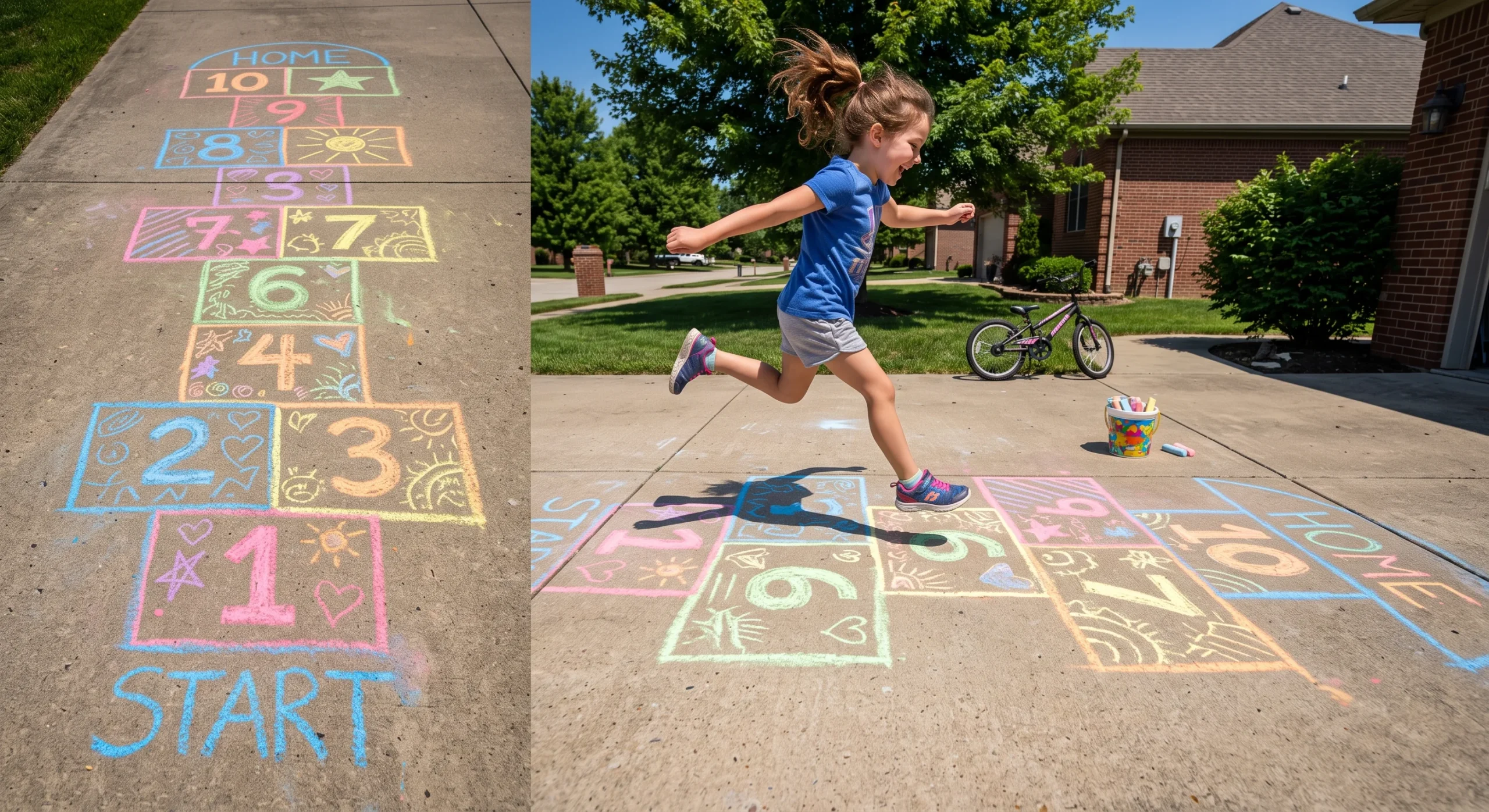
Most people assume math practice has to happen at a table with a pencil, but sidewalk chalk math takes a skill that usually lives on paper — number recognition, basic addition, counting sequences — and moves it outdoors into a full-body activity instead. A hopscotch-style grid with numbers drawn in each square turns a driveway into a genuine practice space, where jumping to the correct answer reinforces the concept through movement rather than repetition on a page. This matters because kids who struggle to sit still for traditional practice often thrive when the same skill is attached to physical activity.
For slightly older kids, writing simple equations into each square instead of plain numbers — landing on the answer to 3 plus 4, for example — extends the same game into real addition and subtraction practice. This costs almost nothing to set up, just a box of chalk and a few open minutes, and it washes away with the next rain, so there’s no pressure to get the layout perfect. It’s a genuinely easy way to sneak math practice into an otherwise ordinary outdoor afternoon.
- Chalk number grids turn basic math practice into a full-body, outdoor activity instead of a worksheet.
- Hopscotch-style games naturally reinforce number recognition and counting sequence through repeated play.
- Adding simple equations to each square works well for slightly older kids practicing addition or subtraction.
DIY Board Games
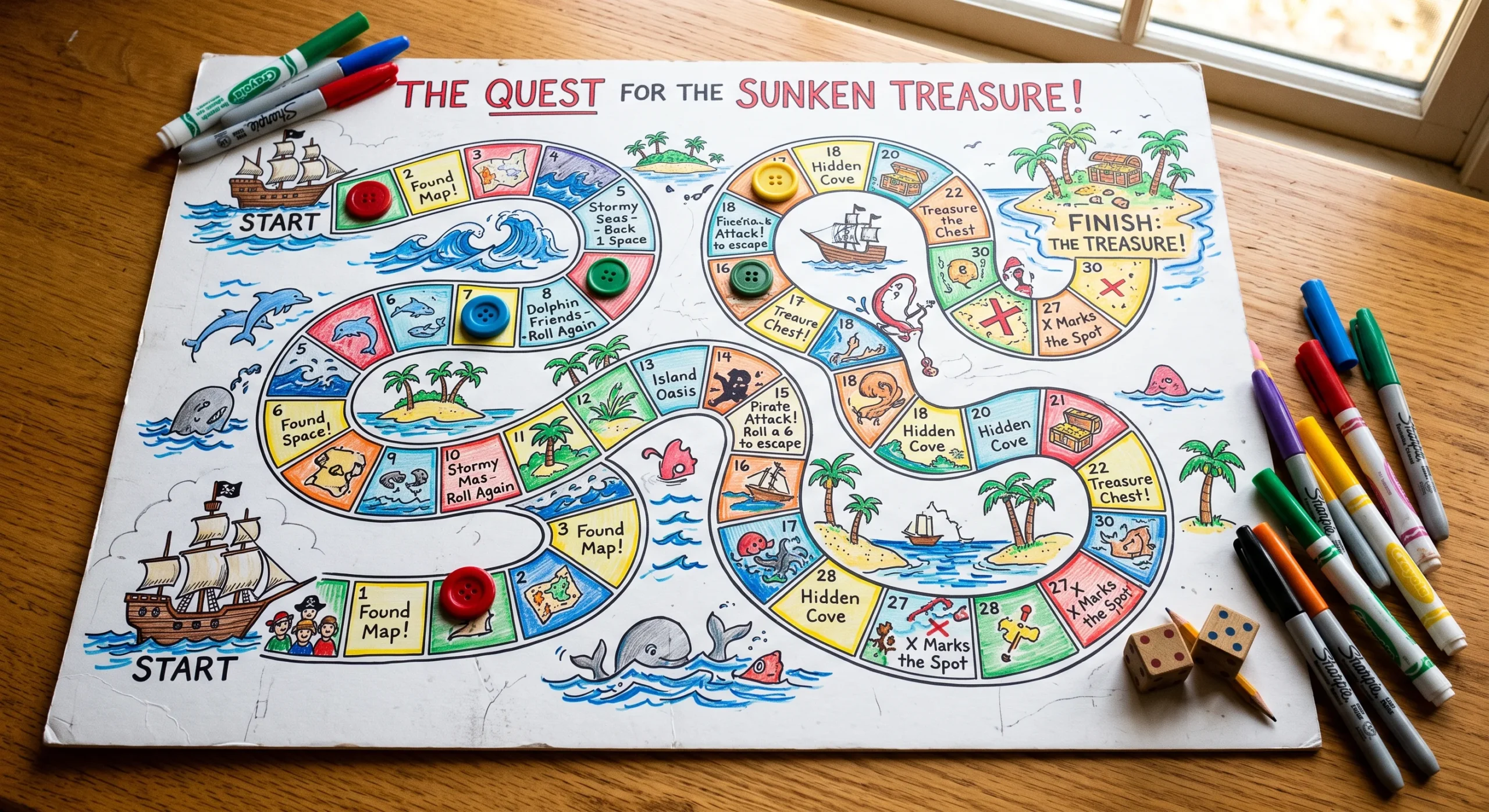
- Designing a board game from scratch builds planning, sequencing, and rule-writing skills all at once.
- Kids naturally practice counting and turn-taking while playing the game they built themselves.
- This works well as a rainy-day project spread across an hour or two, not a five-minute activity.
- Simple materials — poster board, markers, buttons as pieces — keep this activity essentially free.
Designing a board game from scratch asks a child to do something genuinely more complex than playing one: plan a path, decide on rules, and figure out how to explain those rules clearly enough for someone else to follow. That planning and sequencing work builds executive function skills that don’t come up naturally in most other activities on this list, since it requires holding an entire system in mind before a single square gets drawn. This tends to work best as a longer project, stretched across an hour or spread over a couple of afternoons.
Once the game is finished, actually playing it reinforces counting, turn-taking, and following multi-step rules, all wrapped inside something the child is genuinely proud to have made themselves. Materials stay simple and inexpensive — a poster board, some markers, buttons or coins as playing pieces — which keeps this activity accessible without needing anything special from a store. A finished homemade game also tends to get replayed far more than a store-bought one, since there’s real ownership and pride behind every square of it, drawn by the child’s own hand.
Recipe Reading Practice
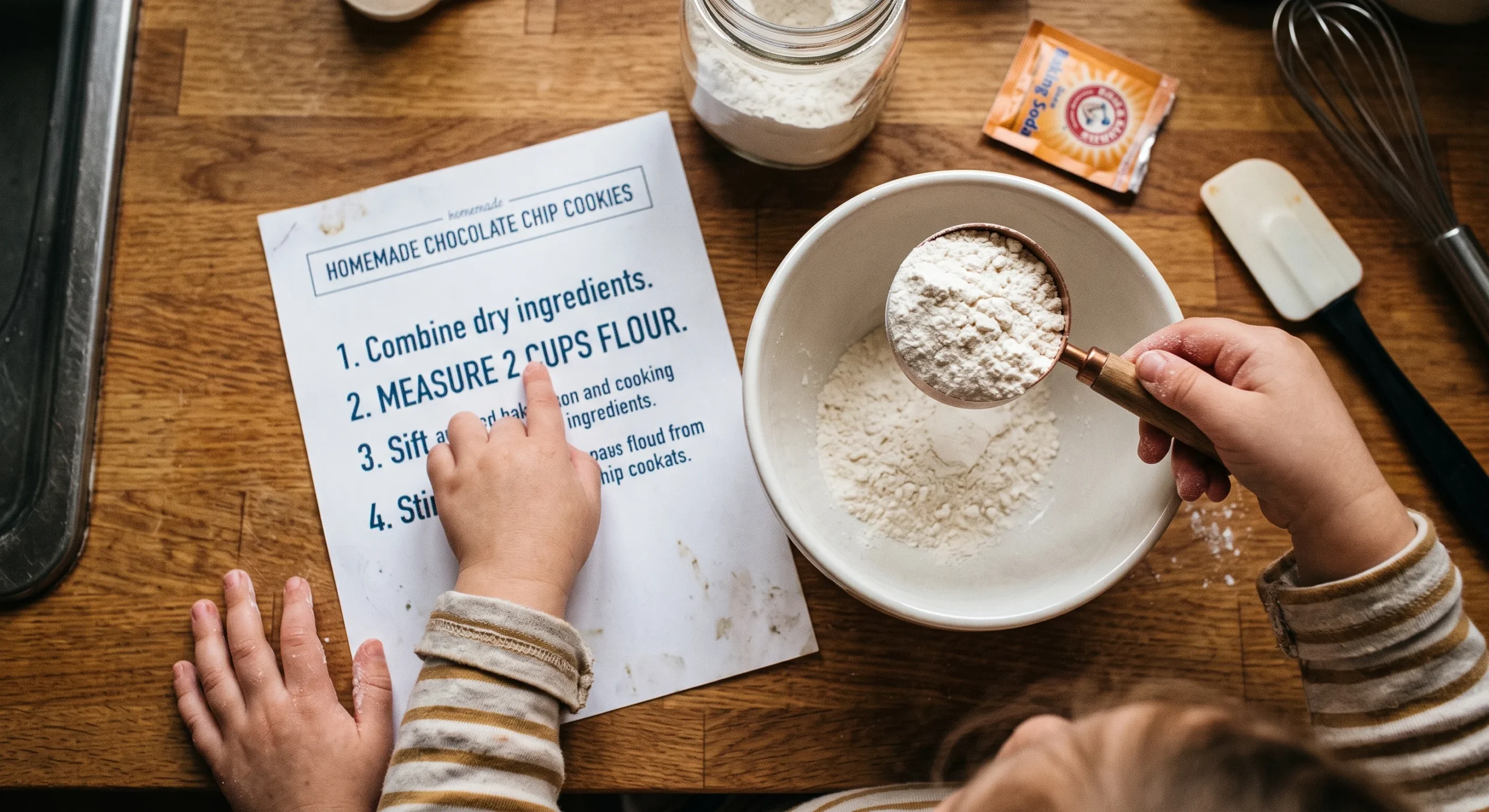
Recipe reading practice combines two skills that usually get taught separately — reading comprehension and math — into one activity that also ends with something to eat, which is a genuine motivator most worksheets can’t offer. Following a recipe step by step requires a child to read for sequence and detail, understanding not just individual words but the order those instructions need to happen in, which is functional reading comprehension in its most practical, real-world form, with a genuinely satisfying, edible result waiting patiently at the very end of it all.
Measuring ingredients along the way reinforces fractions and basic math concepts in a context where getting it wrong has an immediate, understandable consequence — too much flour genuinely changes how the cookies turn out. This is a good activity to start with something genuinely simple, like no-bake energy bites or basic pancakes, before working up to recipes with more steps and more precise measurements. The built-in reward at the end keeps a child engaged through the entire process, start to finish, without needing much extra encouragement.
- Following a written recipe step by step builds sequencing skills and functional reading comprehension.
- Measuring ingredients reinforces fractions and basic math in a genuinely practical, hands-on context.
- This naturally leads to a real reward at the end, which keeps motivation high throughout.
Family Trivia Night
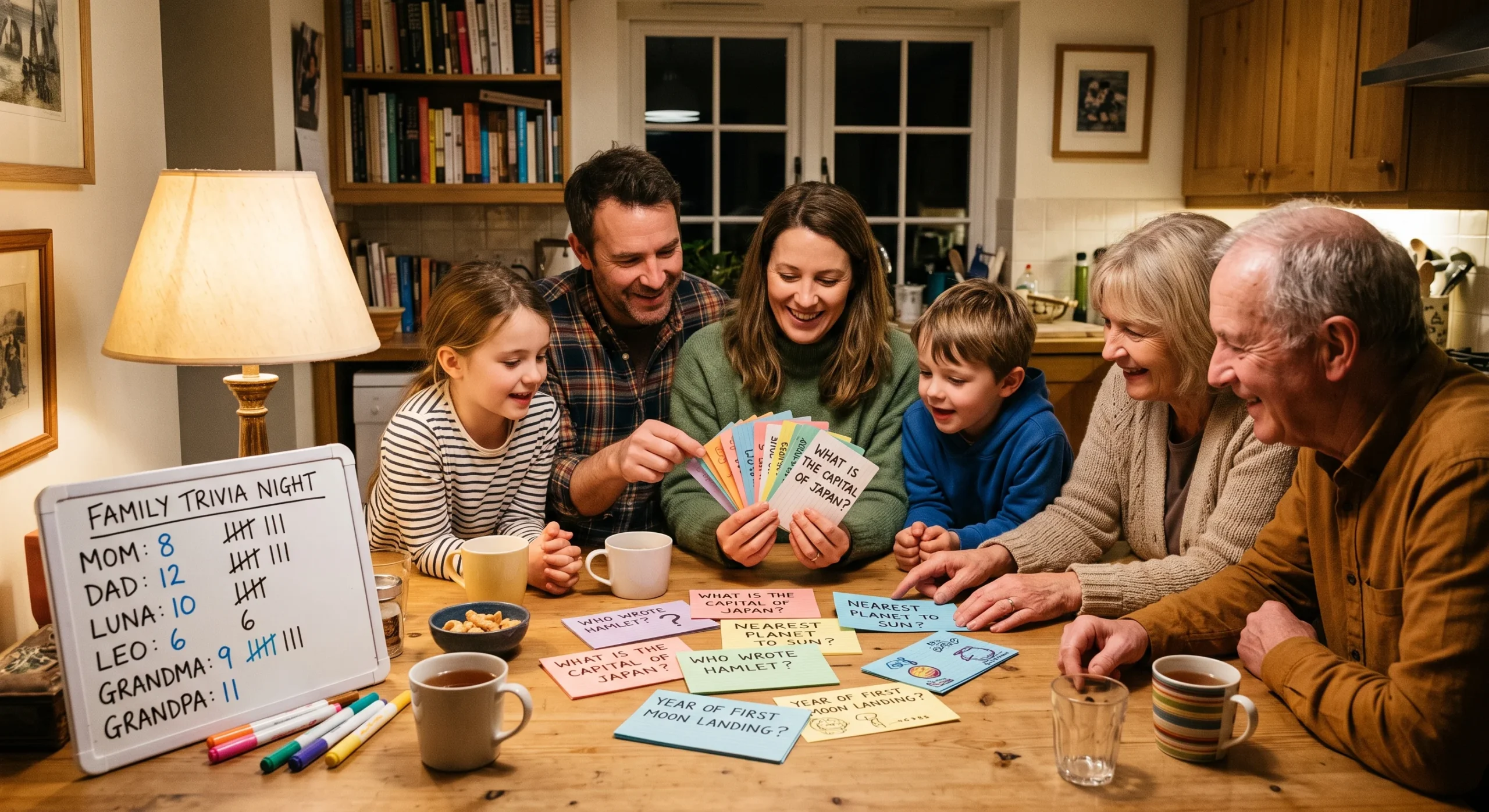
- A simple set of question cards turns family time into low-key, genuinely fun learning practice.
- Mixing categories — science, geography, silly family facts — keeps every family member engaged, not just kids.
- Writing new questions together is its own learning activity, especially for older kids researching answers.
- Works well as a regular weekly tradition rather than a one-time event, building genuine anticipation.
- Keeping score is optional — the conversation and recall practice matter more than winning.
A family trivia night takes the format of a classroom quiz and strips away everything that makes it feel like school, leaving just the genuinely fun parts: recall, curiosity, and a little friendly competition. A simple set of question cards, mixing subjects like science facts, geography, and even silly family-specific trivia, gives everyone from the youngest sibling to a grandparent something they can genuinely contribute to, which is part of what makes this activity work so well across a whole family rather than just for one child.
Writing new questions together between rounds becomes its own small research project, especially for older kids who enjoy digging up an obscure fact nobody else will know. This works particularly well as a recurring weekly tradition rather than a one-off activity, since the anticipation of “trivia night” genuinely builds over time in a way a single activity can’t replicate. Keeping score is entirely optional — the actual value here is in the recall practice and conversation, not in who technically wins each round of the game, so no one feels genuinely left out.
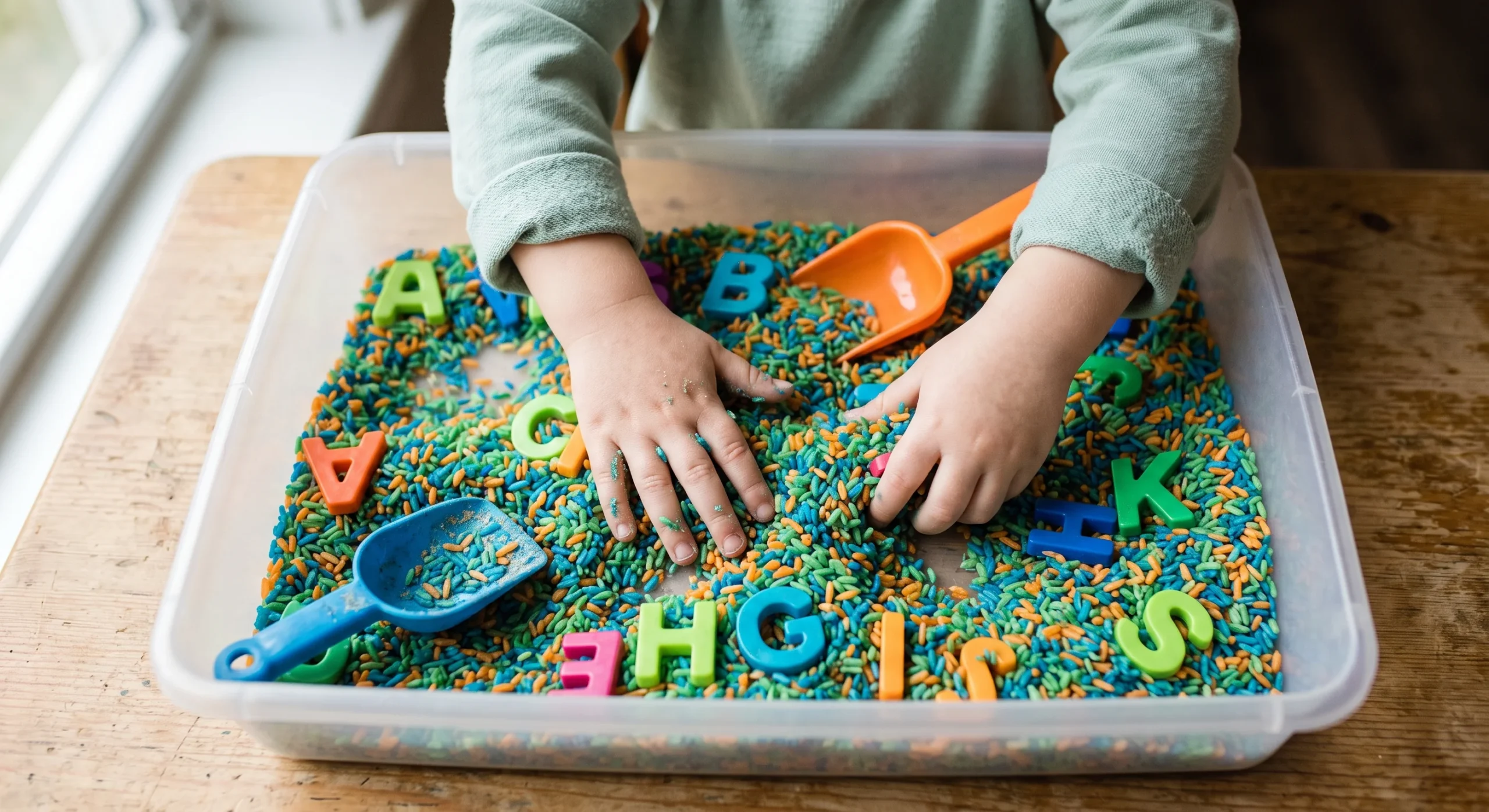
Sensory Bin Exploration
Sensory bin exploration fills a shallow container with something texturally interesting — dyed rice, dried beans, kinetic sand — and lets a child dig, scoop, and pour freely, which delivers a kind of tactile learning that no screen can genuinely replicate. This matters especially for younger kids, whose understanding of the world is still built largely through touch, making hands-on materials a more natural fit than anything purely visual or auditory could offer at that particular developmental stage of early childhood, well before formal instruction takes hold.
Hiding small plastic letters or numbers inside the bin turns simple digging into an active recognition game, rewarding a child each time they uncover and correctly name what they’ve found. This tends to work especially well for kids who have a harder time sitting still for more structured activities, since the physical digging itself provides a genuine outlet for movement alongside the learning. A basic bin, once assembled, can be reused and re-themed for weeks with very little additional effort from a parent beyond swapping out a few small hidden items.
- A bin filled with rice, beans, or sand provides genuine tactile learning that screens simply can’t replicate.
- Hiding small letters or numbers inside turns simple digging into an active recognition game.
- This tends to work especially well for younger kids who benefit from hands-on, sensory-based learning.
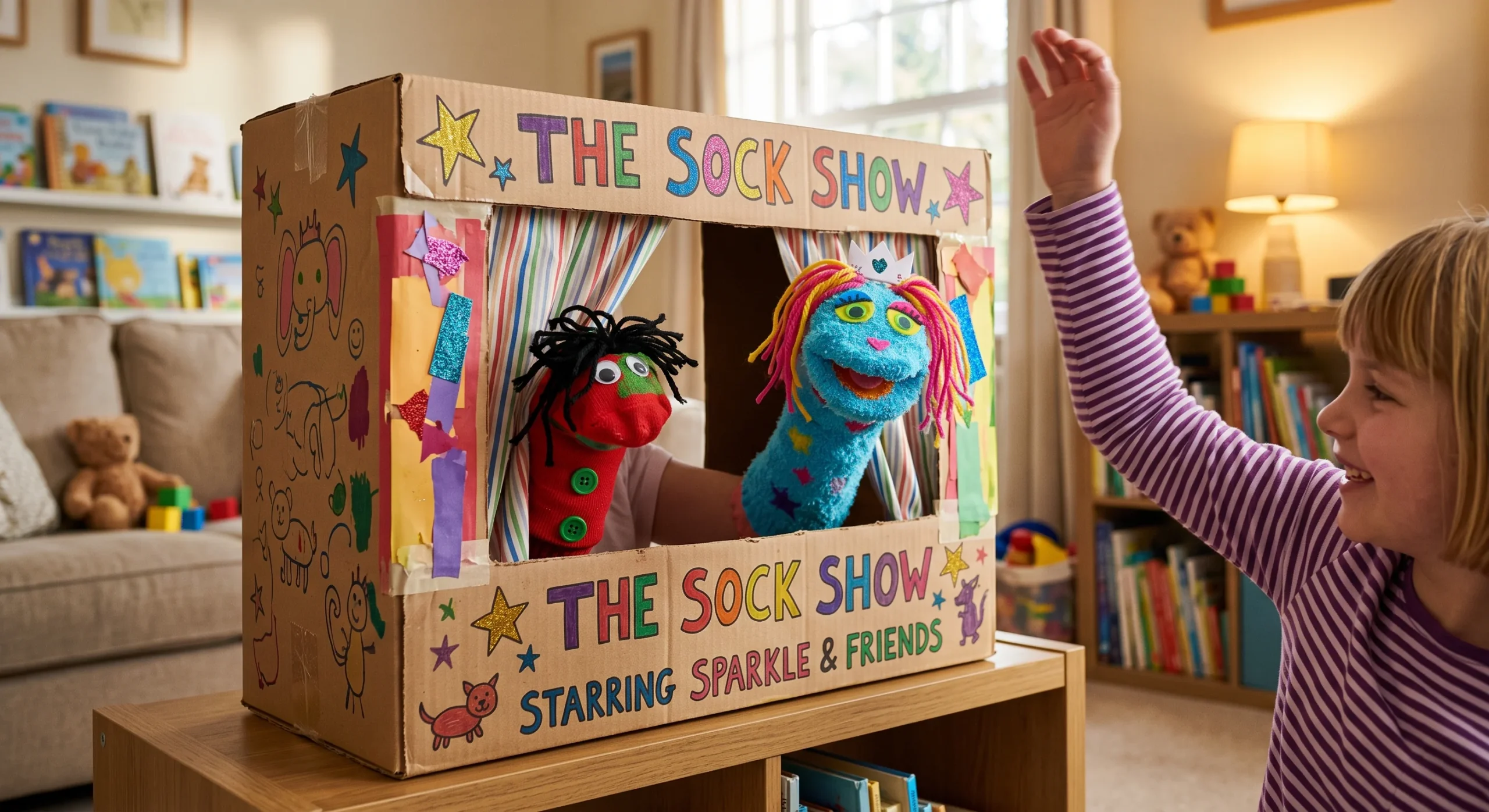
Puppet Show Creation
Puppet show creation asks a child to build a small world from scratch — characters, a simple plot, even a makeshift stage out of a cardboard box — and then perform it, which quietly combines storytelling, sequencing, and public speaking practice into one genuinely playful activity. Sock puppets or paper bag puppets cost almost nothing to make, and the actual crafting process is its own valuable step, building fine motor skills through cutting, gluing, and decorating well before the performance itself ever actually begins, which makes the whole activity worthwhile even if the show never happens.
Performing the finished show, even just for a parent or a sibling, builds a specific kind of confidence that’s genuinely hard to practice any other way — speaking in front of an audience, staying in character, and improvising when a line gets forgotten mid-scene. In my years of teaching, the shyest students in a classroom often opened up the most when speaking through a puppet rather than as themselves, since the puppet absorbs some of the spotlight. This makes it a particularly good activity for a genuinely reserved child.
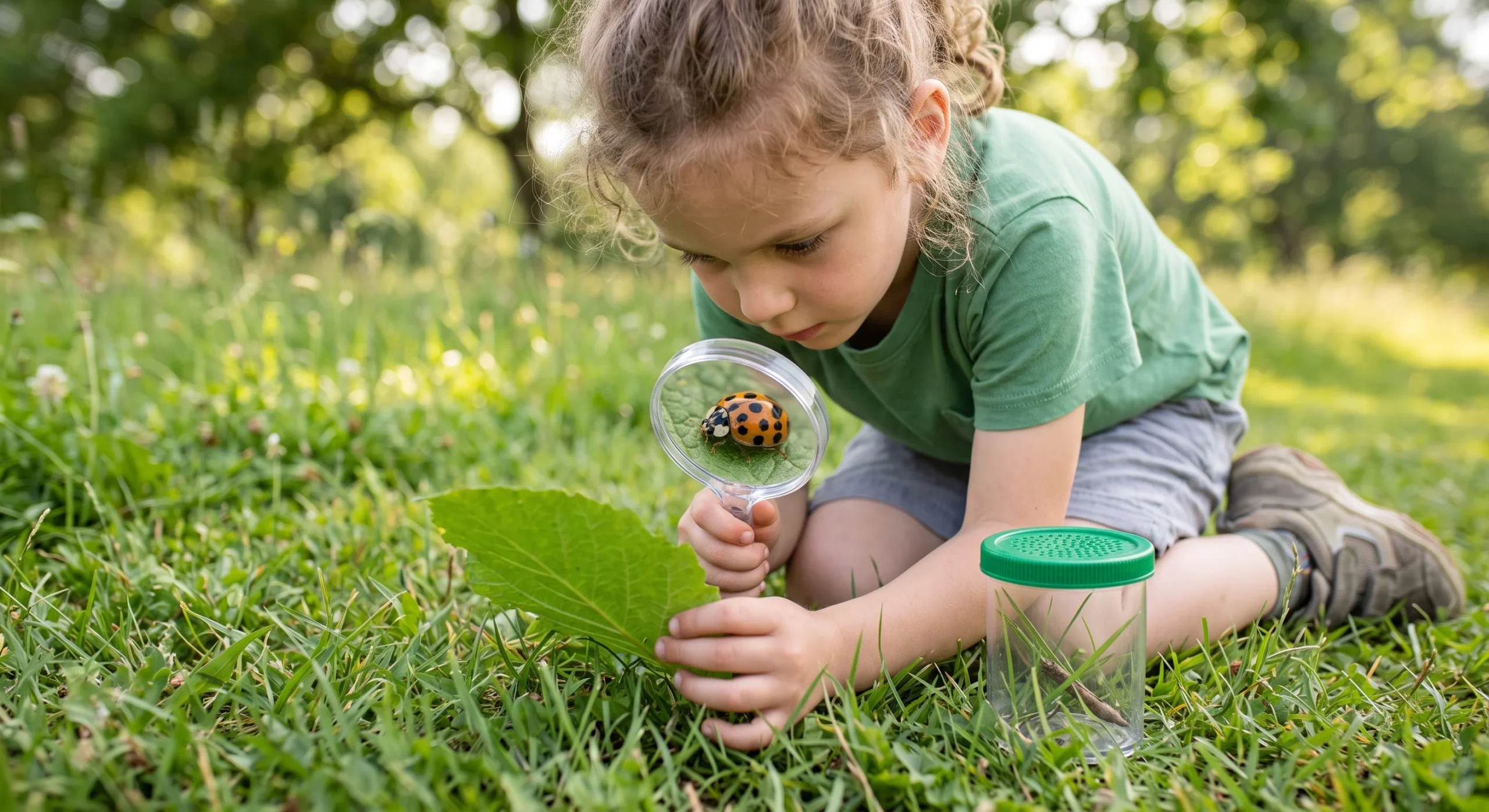
Backyard Bug Hunt
- A magnifying glass and a jar turn an ordinary backyard into a genuine field research station.
- Observing and sketching what’s found builds early scientific documentation skills, the same ones real researchers use.
- Releasing insects afterward teaches a small, genuine lesson in respecting living things.
- Works well in nearly any outdoor space, even a small apartment balcony with a few potted plants.
A backyard bug hunt turns an ordinary patch of grass into a genuine field research station, using nothing more than a magnifying glass and a jar with a few air holes poked in the lid. Observing insects up close — counting legs, noticing colors and patterns, watching how they move — builds the same careful observation skills that real field scientists rely on, introduced here in a form that’s genuinely exciting for a child rather than abstract, textbook-based, or hard to picture from a page alone.
Sketching what’s found in a simple notebook afterward adds a documentation step that mirrors how actual researchers record their observations, turning a fun outdoor moment into a small habit of noticing and recording detail. Releasing each insect back where it was found afterward teaches a gentle, genuine lesson in respecting living things rather than treating them as disposable playthings. This activity works in nearly any outdoor space, even a small balcony with a couple of potted plants, so it isn’t limited to families with a large yard.
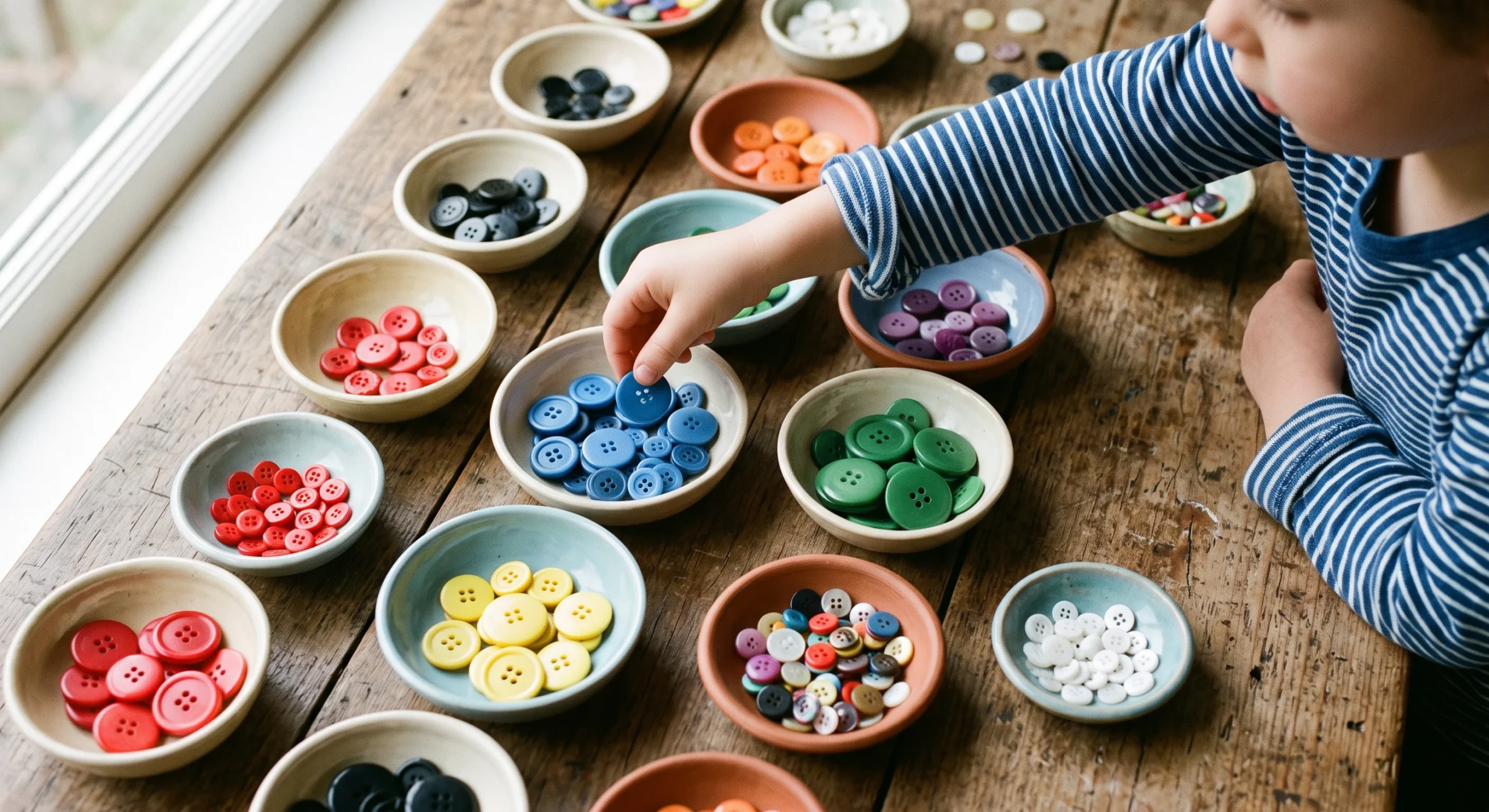
Sorting and Pattern Games
Sorting and pattern games use whatever small objects are already lying around — buttons, coins, pasta shapes, mismatched socks — to build foundational math thinking well before a child is ready to work with actual numbers. Sorting by one attribute at a time, first color, then size, then shape, teaches classification, which is the quiet groundwork underneath almost every later math concept a child will encounter in school. This is a genuinely easy activity to fold into an ordinary afternoon, since it needs no special preparation and can start and stop at any point without losing its value.
Extending a simple pattern — red, blue, red, blue, and asking what comes next — introduces early algebraic reasoning, the kind of thinking that later supports actual equations, in a form that feels completely like play right now. This costs nothing extra to set up, since the materials are almost always already in a kitchen drawer or craft bin somewhere in the house. It’s a good five-minute activity to keep in your back pocket for a moment when nothing else is holding a child’s attention.
- Sorting everyday objects by color, size, or shape builds foundational math thinking before numbers even come into it.
- Extending a pattern (red, blue, red, blue…) with household items builds early algebraic reasoning.
- Buttons, coins, and pasta shapes all work well and cost nothing extra to set up.
Letter Hunt Walks
- Spotting letters on signs, license plates, and storefronts turns an ordinary walk into active literacy practice.
- This works especially well for kids just starting to learn the alphabet or early reading.
- A simple checklist of target letters adds just enough structure without feeling like a worksheet.
- No materials needed beyond a pencil and paper, making this one of the easiest ideas on this list.
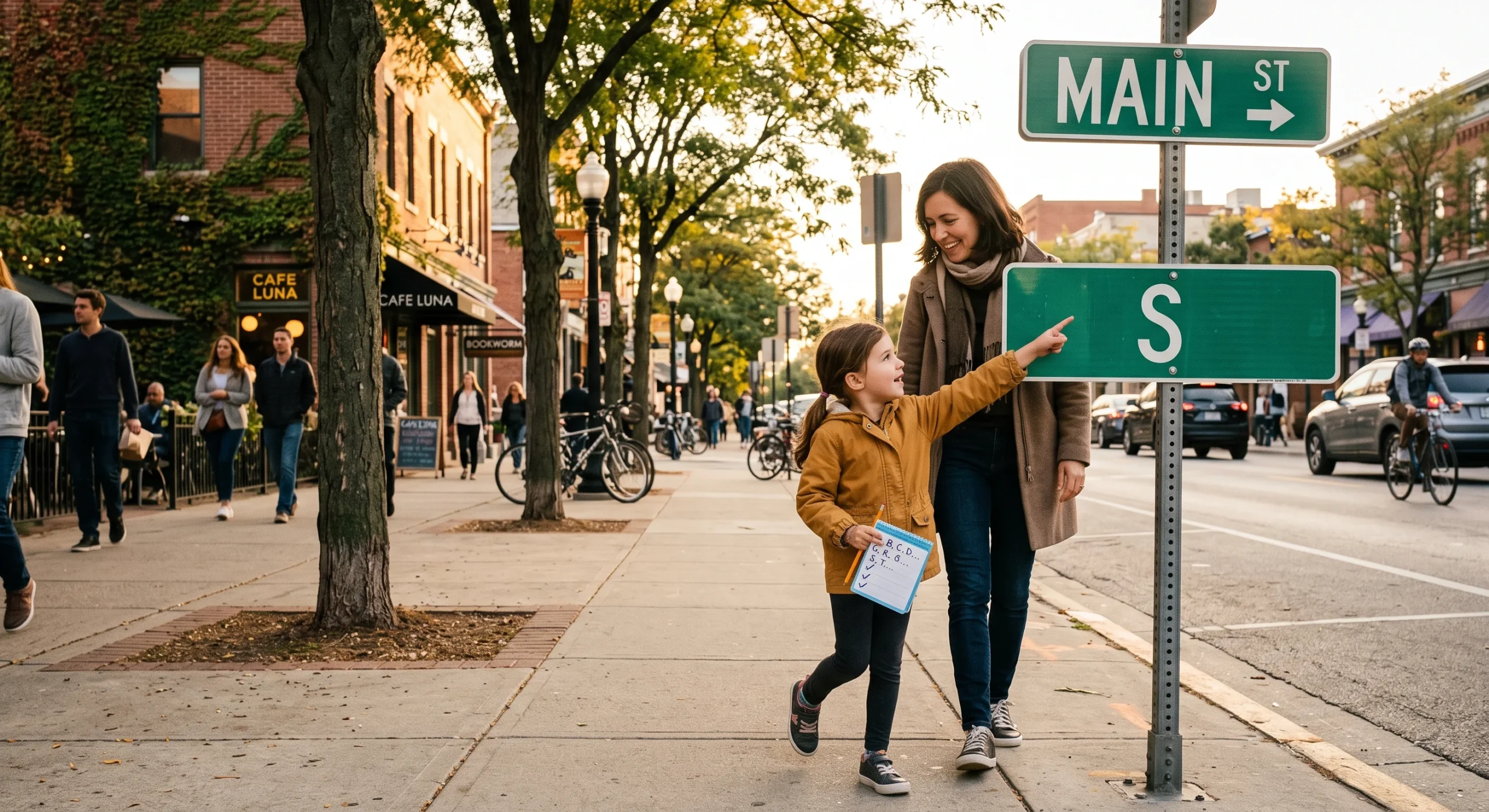
A letter hunt walk takes early literacy practice out of a workbook and puts it directly into the real world, where letters already surround us on street signs, storefronts, and license plates. Asking a child to spot a specific letter, or check off a short list of several, turns an ordinary errand or walk around the block into active reading practice without them necessarily realizing that’s what’s happening. This works especially well for kids just beginning to learn the alphabet, since real-world letters come in far more shapes and fonts than a single workbook page ever shows.
A simple checklist, just five or six target letters written on a small notepad, adds enough structure to keep the activity focused without turning it into something that feels like schoolwork. This is genuinely one of the easiest ideas on this entire list to set up, requiring nothing beyond a pencil and a scrap of paper, and it works during errands you were already running anyway. It’s a good default activity for any walk where you don’t want to plan something more involved ahead of time.
Simple Coding Unplugged
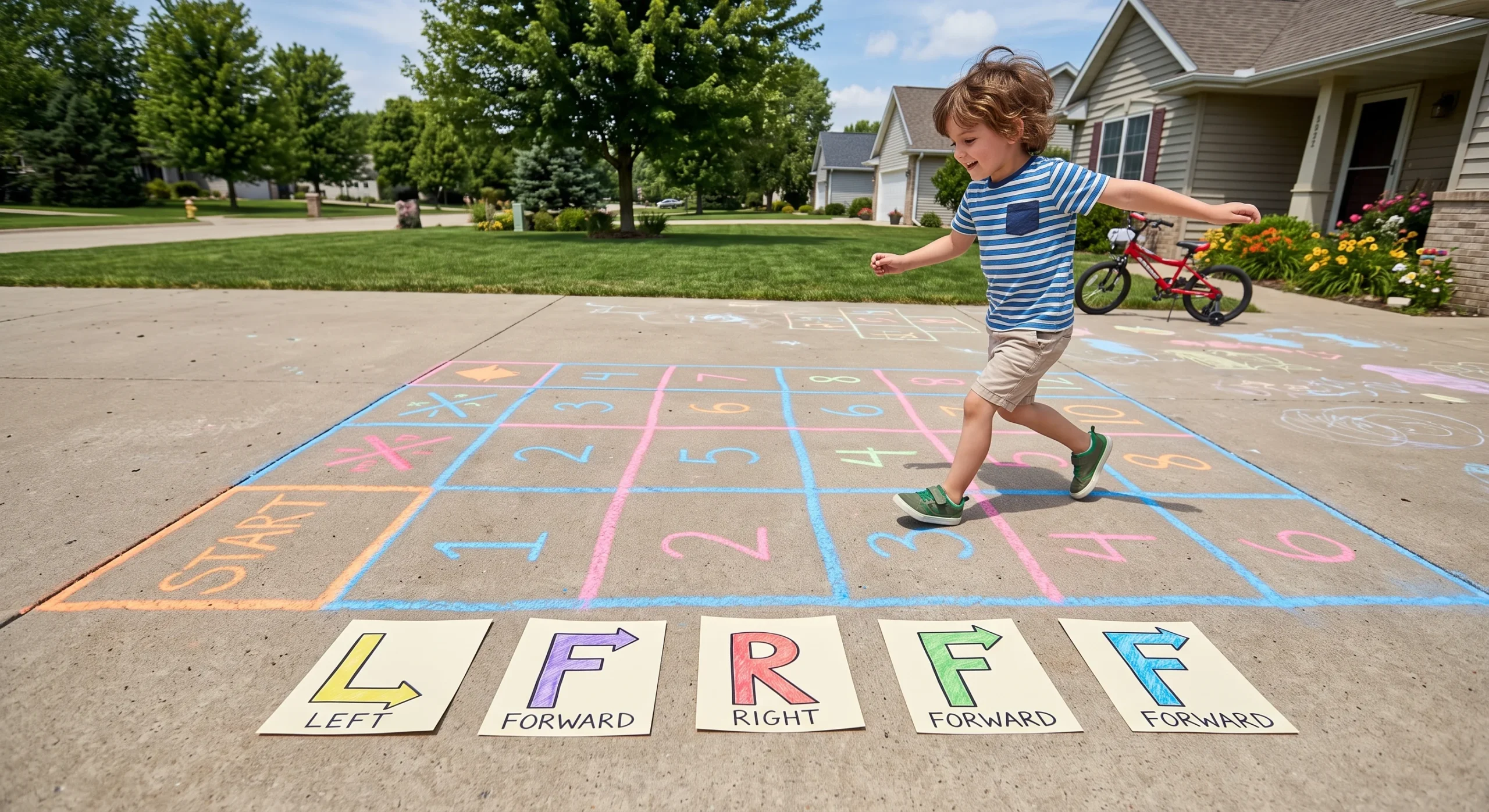
Simple coding unplugged teaches the actual logic behind programming — sequencing, step-by-step instructions, if-then thinking — using nothing more than a few printed arrow cards and a grid drawn on the floor or driveway. A child lays out a sequence of cards (forward, forward, turn left, forward) and then physically walks the path those cards describe, essentially acting as their own robot following a written program. This builds real computational thinking well before a child ever touches an actual keyboard, coding app, or classroom computer.
Debugging becomes part of the game naturally, since a wrong turn means physically ending up in the wrong square, which a child can see and correct by rethinking the sequence rather than being told the answer directly. This adapts easily to whatever space is available, working just as well with a chalk grid on a driveway as with a taped-off grid on a living room floor during a rainy afternoon. It’s a genuinely screen-free way to introduce a skill that’s becoming increasingly valuable well before formal schooling requires it.
- Arrow cards (forward, turn left, turn right) teach real coding logic without any screen or device involved.
- Walking through a sequence step by step builds the same if-then thinking used in actual programming.
- This works well indoors or outdoors, adapting easily to whatever space is available that day.
Journaling With Prompts
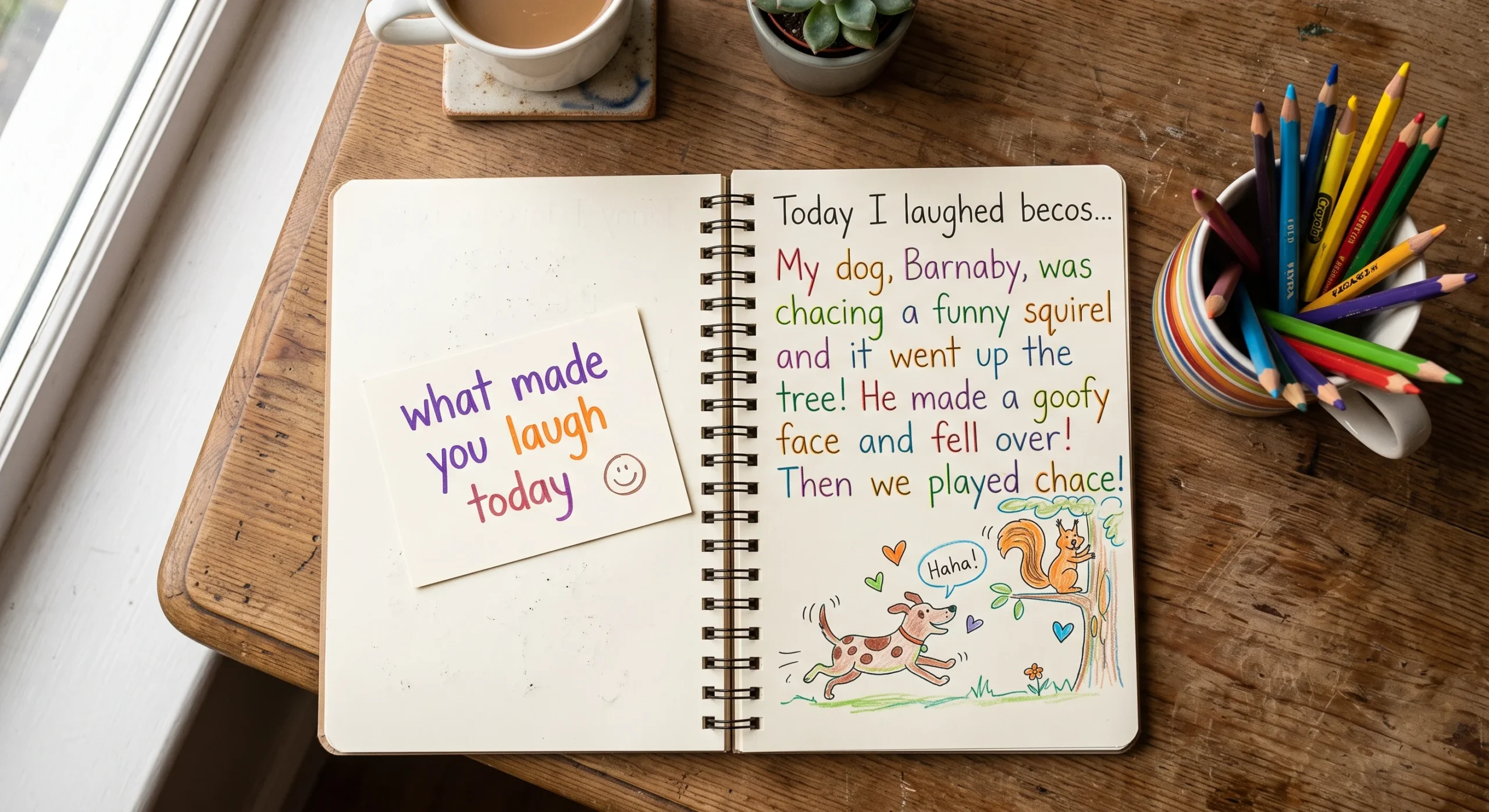
Journaling with simple prompts gives a child a genuine outlet for writing practice that isn’t tied to a grade or a correction, which changes the entire relationship many kids have with putting words on paper. A prompt like “what made you laugh today” or “describe your favorite place” removes the blank-page intimidation that stops a lot of kids from wanting to write at all, replacing it with a specific, manageable starting point. This builds writing fluency the same way regular reading builds vocabulary — through consistent, low-pressure repetition rather than occasional, high-stakes assignments.
In my own classroom, the students who resisted writing the most often came around once journaling stopped being judged for spelling or grammar and simply became a space to think on paper. A simple notebook and a rotating stack of prompt cards is genuinely all this requires, and even five minutes a day adds up to real, visible improvement over a school year. This is worth treating as a quiet daily habit rather than a special occasion activity, since consistency matters more here than length.
Map Reading Adventures
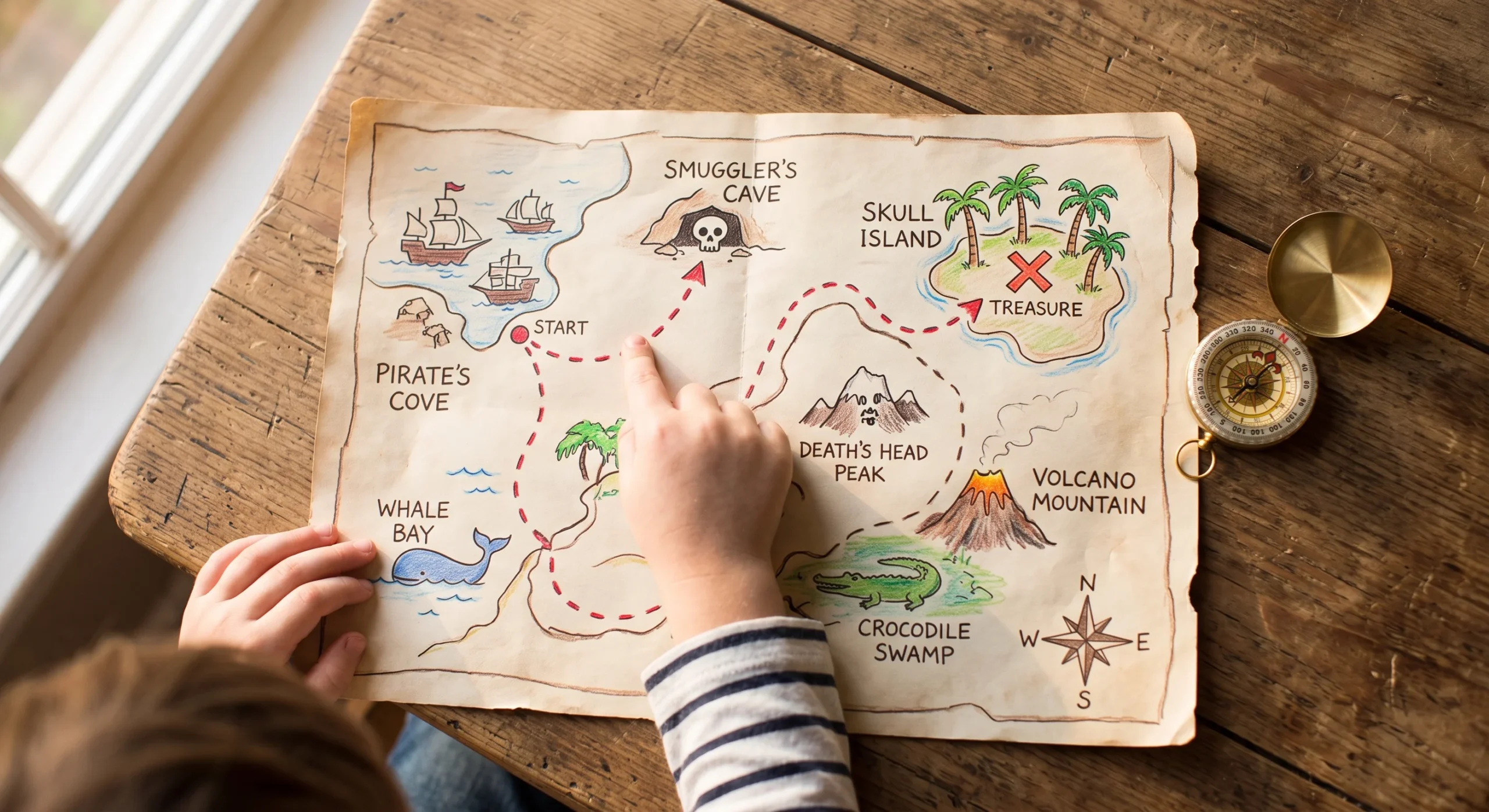
Map reading adventures turn an abstract skill — interpreting symbols, understanding scale, following a route — into a genuinely exciting hunt for something at the end. A simple hand-drawn treasure map, marking landmarks around a house or backyard, teaches a child to translate a two-dimensional drawing into real physical movement through space, which is a foundational skill that later supports actual geography and even basic navigation. This works well as a surprise activity, with a small reward waiting at the map’s final marked spot to keep the motivation genuinely high.
As kids get more comfortable with the basic concept, introducing a real neighborhood map or a simple compass adds genuine complexity, building an understanding of direction and scale that a purely imaginative treasure map doesn’t quite require. This tends to work especially well for kids who respond to physical, movement-based learning over sitting still with a worksheet, since the entire activity is built around walking, searching, and discovering. A completed hunt also builds a real sense of accomplishment that’s hard to replicate with a screen-based alternative.
Music and Rhythm Games
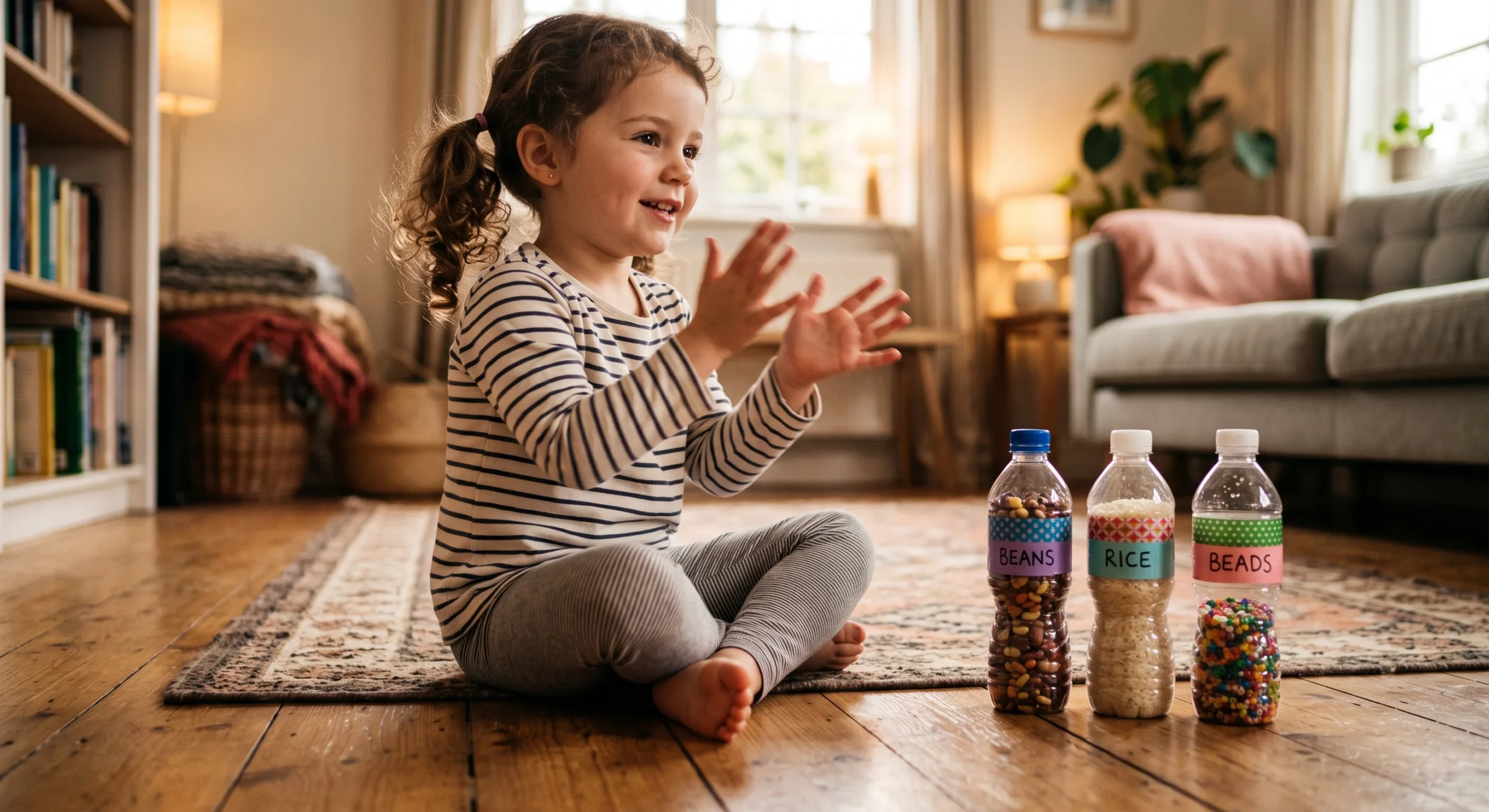
Music and rhythm games build a surprising range of academic skills hiding inside something that feels purely like fun — clapping a repeated pattern, for instance, quietly practices the same sequencing and pattern-recognition thinking that later supports reading and math. Simple homemade instruments, like a set of shakers made from dried rice sealed inside small water bottles, cost almost nothing and turn an ordinary afternoon into an impromptu music session without needing any real instrument, lesson, or prior musical experience involved from anyone in the room.
Call-and-response clapping games, where a leader claps a pattern and the group repeats it back, build genuine listening skills and short-term memory, both of which transfer directly into a classroom setting even though the activity itself feels entirely unrelated to school. This works well as a group activity with siblings or friends, since the back-and-forth format naturally requires taking turns and paying close attention to whoever is leading. It’s a good option specifically for a child who has a hard time sitting still for quieter activities.
Gardening Together
- Planting seeds and tracking growth teaches real patience and a basic understanding of life cycles.
- Measuring and recording plant height over time builds early data-tracking and observation skills.
- Even a single pot on a windowsill works — this doesn’t require an actual backyard garden.
- Caring for something living builds a genuine sense of responsibility that few other activities replicate.
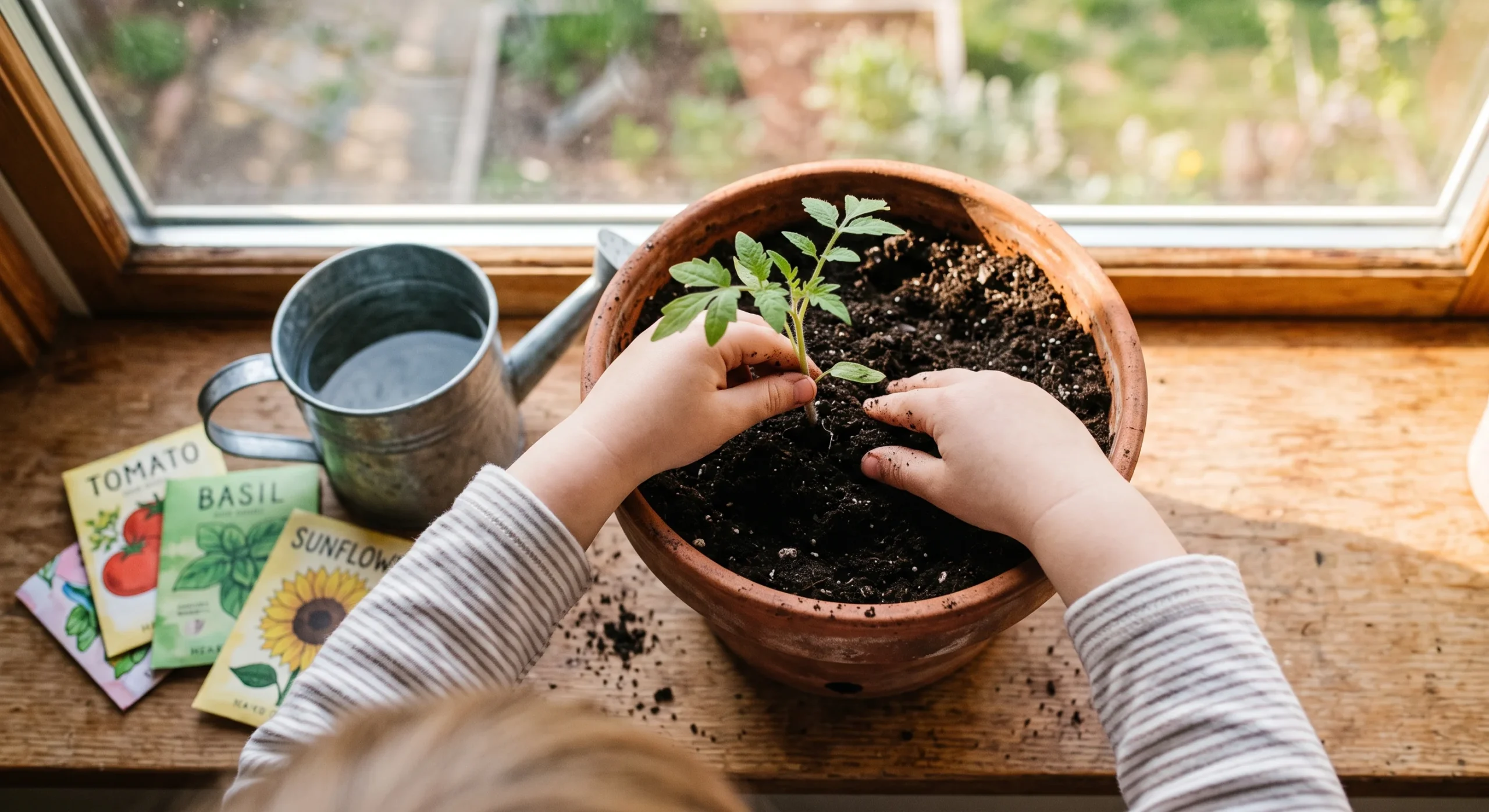
Gardening together teaches patience in a way that almost nothing else on this list can, since a planted seed simply won’t grow any faster no matter how eagerly a child checks on it each morning. That built-in waiting period becomes a genuine, low-pressure lesson in delayed gratification, alongside a basic, hands-on understanding of life cycles that a textbook diagram can only partially convey. This works just as well with a single pot on a sunny windowsill as it does with an actual backyard garden bed, so a lack of outdoor space isn’t a real barrier here.
Measuring and recording plant height every few days, even with a simple ruler and a notebook, builds early data-tracking and observation skills, turning the garden into a small ongoing science project rather than a one-time planting activity. Caring for something living also builds a genuine sense of responsibility that’s difficult to replicate through toys or screens, since a plant’s wellbeing depends directly on a child remembering to water it. Fast-growing options like beans or sunflowers tend to hold a child’s interest best, since visible progress happens within just a week or two.
Memory Card Games
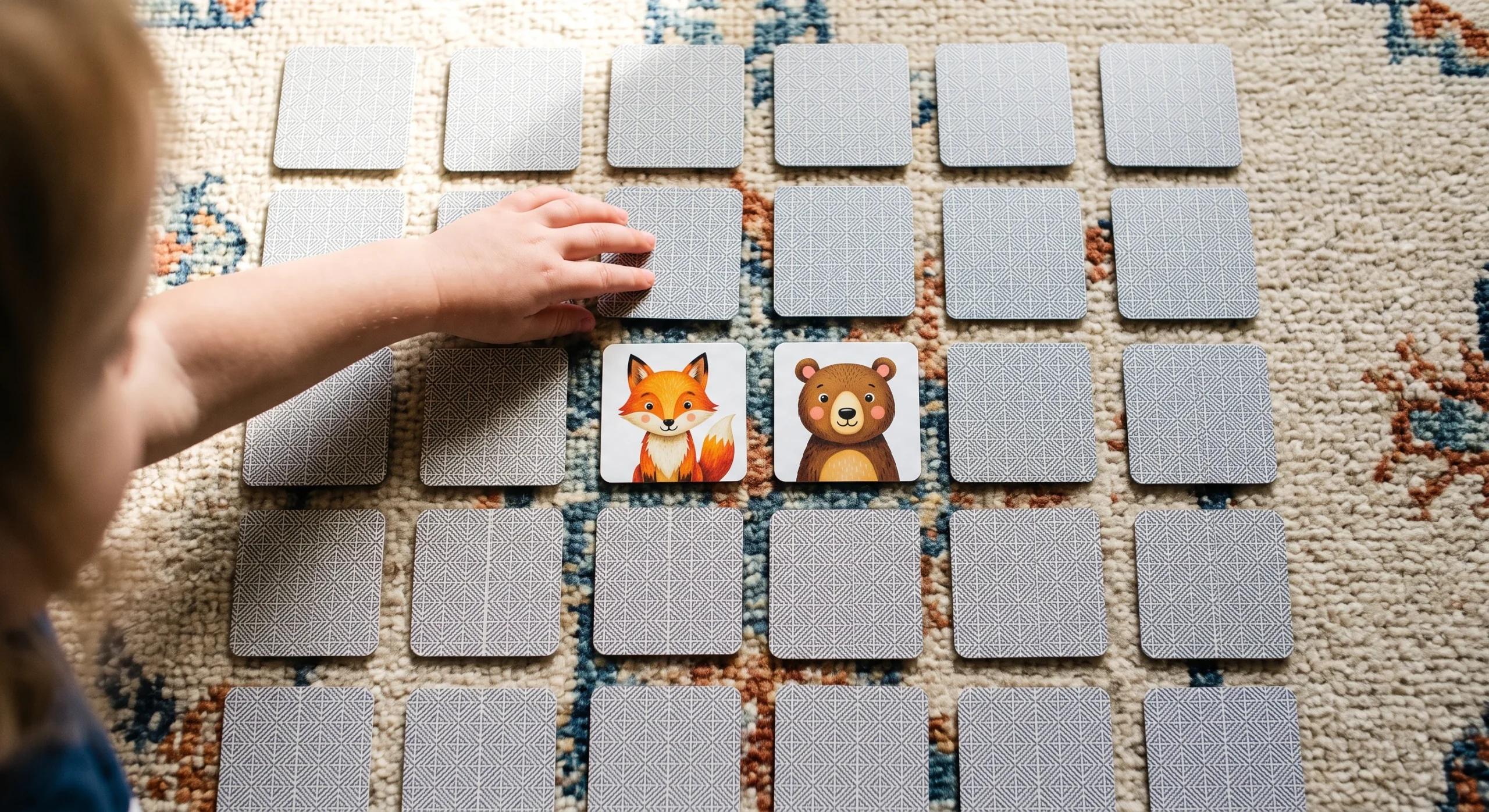
Memory card games close out this list because they build one of the most transferable skills on it — concentration and short-term recall — through an activity that genuinely doesn’t feel like practice at all. Flipping two cards at a time, trying to remember where a matching pair was seen a few turns earlier, exercises working memory in a focused, repeated way that few other games manage this naturally. A simple set of index cards, drawn with matching pairs of pictures, costs nothing and works just as well as any store-bought version.
Adjusting the grid size is an easy way to scale the difficulty, starting with just six or eight cards for a younger child and expanding to a larger grid as their memory and patience develop over time. This is one of the most flexible activities on the entire list, genuinely working for a wide range of ages with nothing more than a simple size adjustment. It’s a good one to keep on hand permanently, since a deck of homemade cards takes up almost no space and never really wears out.
- Classic memory matching games build concentration and short-term recall through genuinely enjoyable repetition.
- Homemade versions using index cards keep this activity free and easily customizable to any theme.
- This closes out the list well, since it works for nearly any age with simple difficulty adjustments.
FAQ
How much screen time should kids actually have each day?
Recommendations vary by age, but most pediatric guidelines suggest limiting recreational screen time to one to two hours a day for school-age kids. What matters just as much as the number is having genuinely engaging alternatives ready, so screens aren’t simply the default when boredom hits.
My child says these activities are boring compared to their tablet — what do I do?
This is genuinely common at first, especially if screens have been the primary source of entertainment for a while. In my experience, sticking with one or two activities consistently for a couple of weeks, rather than switching constantly, usually gives kids enough time to actually settle into the slower pace and start enjoying it.
Do these activities work for kids with different learning styles?
Yes — that’s actually part of why this list includes such a mix. The hands-on options like sensory bins and building challenges tend to suit kinesthetic learners, while storytelling and journaling activities lean more toward kids who process through language, so there’s genuinely something here regardless of how your child learns best.
How do I fit these in with an already busy family schedule?
Start with just one activity a few times a week rather than trying to fill every screen-free moment — even fifteen minutes of genuine engagement does more than an hour of half-hearted effort. Many of these, like letter hunt walks or sidewalk chalk math, also fit naturally into time you’re already spending on errands or outdoor play.
Conclusion
Cutting back on screens doesn’t have to mean a harder afternoon for anyone — the right screen time alternatives for kids actually make the day easier once a child settles into them, because genuine engagement holds attention far longer than passive scrolling ever does. Start with whichever idea matches your child’s energy that day, whether that’s a quiet journaling prompt or an energetic backyard bug hunt, and let the rest build from there. Save this list to Pinterest for the next low-energy afternoon, try one activity this week, and pass it along to another parent who could use a few fresh ideas.